A Place Where It Connects: The Art of Marcie Miller Gross
By: A. Bitterman
April 2006
Review Studios
Marcie Miller Gross: foldoverfold
Kemper Museum of Contemporary Art
Kansas City, Missouri
December 16, 2005-January 29, 2006
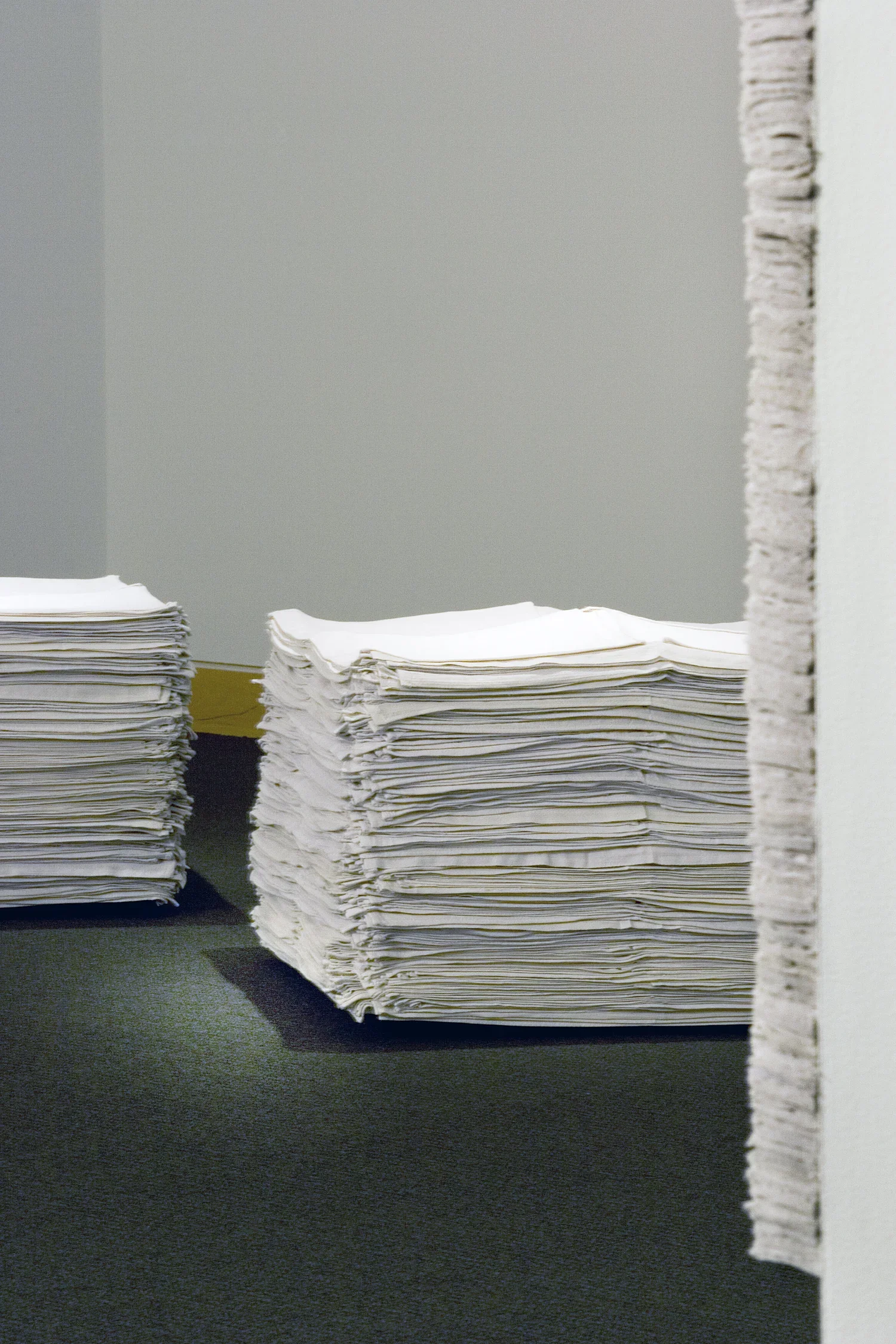
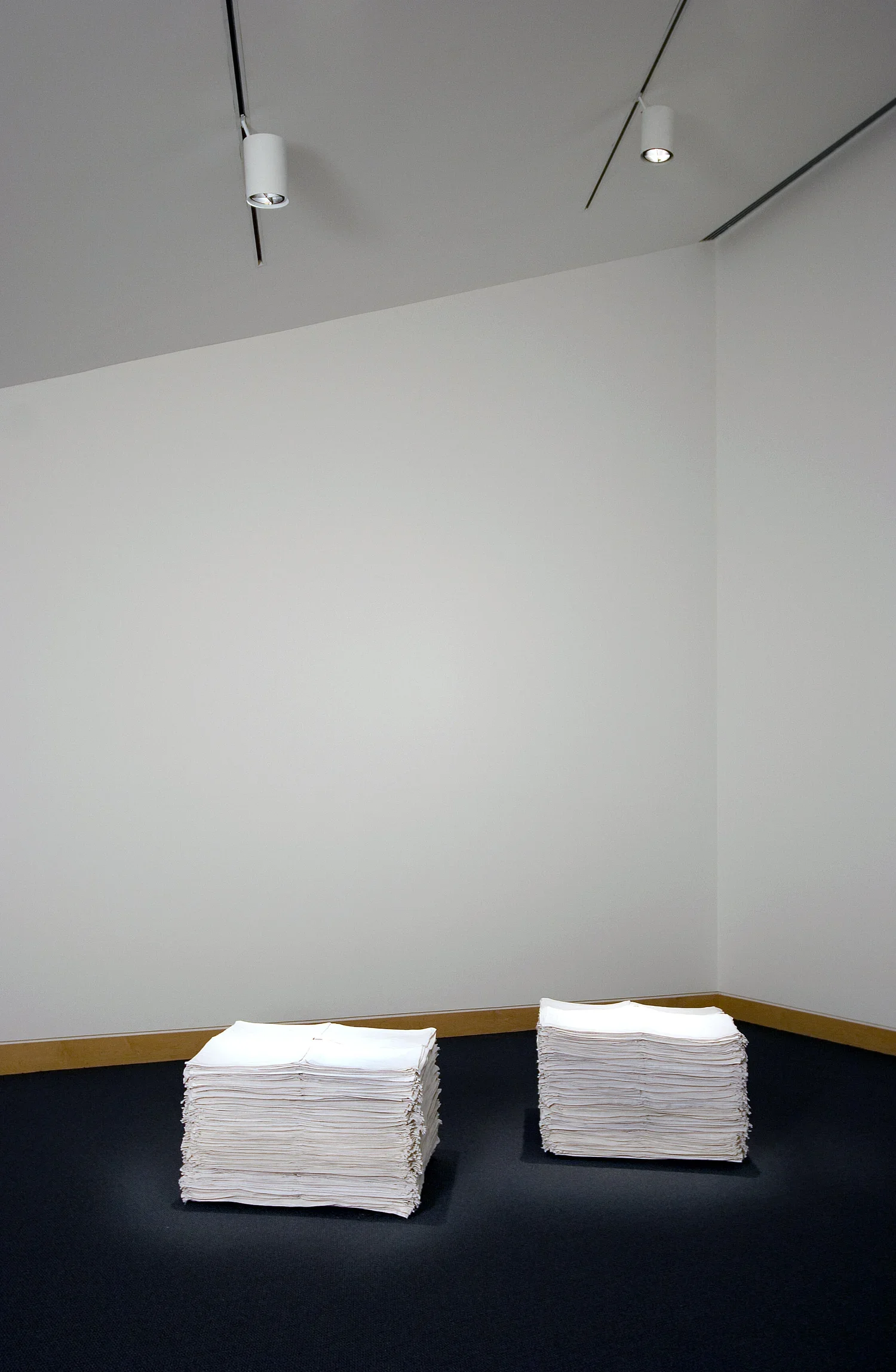
Image caption: Marcie Miller Gross, Edge & Rotation, 2006, from foldoverfold, Kemper Museum of Contemporary Art.
My kids don’t like art museums much. Actually, what they don’t like is to go see art in art museums. There are other things they like more about museums, like good hiding places, or sweeping staircases, or the interesting handles on the bathroom fixtures, or just the way the apples are cut for the fruit plate in the museum restaurant.
It’s a fatiguing process, looking at art in museums, and there’s a false air of discovery about the whole business of looking at things already sanctified by market or by assertion. If you like the work, you’re just another brick in the wall. If you don’t like the work, you obviously don’t understand it. Kids don’t suffer over this stuff. They are masters of escape. They just find other things to look at, other things to do. They see the whole space. The only things they really keep a fix on are the security guards.
On a recent visit to the Kemper Museum to see the foldoverfold exhibit by Marcie Miller Gross, I was admonished by a guard for leaning against the wall, advised that I could not use a pen to write notes in the gallery, and instructed as to the proper distance I should keep from artwork itself. Shit, I guess I was looking too hard. All of this on video, it was rather like visiting a casino. And usually the house always wins. But in the case of foldoverfold, it is safe to say that Gross beat the odds and trumped the house. This may seem an odd analogy until you realize that foldoverfold was an inside job.
I had the good fortune of visiting Gross in her studio prior to the Kemper exhibit, to see the work in progress, without surveillance, and without pretense. Gross lacks, to her credit, the usual artist’s sangfroid. So many younger artists adopt an aloof aspect toward their work, as if they are involved in a bad marriage, as if being an artist precedes the consequence of their art. More serious artists exchange this tortured mystique for the self-styled rhetorical responsibility that their work demands.
In either case, it’s nearly impossible to discern anymore the originality of any given artistic enterprise. We’ve moved well beyond the shock-culture of the late 20th century and with it the notion of transcendence. Bling is boring. Cleverness is annoying. Zen is suspicious. Institutional critique is … yawn. In this day and age, a simple feeling would suffice. And on that score, Gross delivers; perhaps this is because she possesses that rare quality among artists: reasonable doubt.
Gross’s studio is large and bright and workmanlike. There is no sense of imminent existential crisis here. Rather, there is an order of things that provides, dare I say, a Borgesian glimpse into the mind of the artist. A ratio, really, of priorities. There’s the question of legacy which occupies perhaps 10 percent of Gross’s studio, in the form of accumulated texts and the remnants of her previous work, stored in shelving units and in side rooms. The element of craft resides in the half dozen or so work tables and desks that delineate another 10 percent of the studio. Then there are the towels, the artist’s raw materials, which seem ubiquitous but in physical terms claim maybe yet another 10 percent of the studio. What remains is space. What that suggests, above all else, is that the studio itself is a site. Or, more precisely, a test site. In this regard, Gross is embraced by a perpetual state of possibility.
It seems natural that the prevailing discourse surrounding Gross’s work to date tends toward the material nature of her art and the realms of association that arise from it. Gross sculpts in towels, layering, stacking, folding, cutting, piling, pressing, sometimes washing, refolding, restacking, and towels are curious things. They possess an endless variety of preset meanings and possible meanings in terms of origin, functionality, cultural, and/or political innuendo. On the other hand, towels are towels, and they reveal form just like any other material, like paint, or wood, or steel. It is relevant to consider the intent of the towel as a harbinger of dissociative domesticity, for instance, or to examine the industrial memory of the material vis-a-vis the sanitized environs of an exhibition space, but it’s a risky place to dwell, a rabbit hole of speculative criticism that threatens to reduce the larger ideas that are beginning to show up in Gross’s work.
Gross has been working earnestly with towels for the better part of a decade. Once you dedicate yourself to a medium like this, coming to terms with it takes a long time and, like most relationships, begins on a very physical level of play and experimentation. Some of Gross’s early towel pieces, circa 2000, bath towels drenched in mud, folded and stacked and left to dry on makeshift plinths and old furniture, testify to this quite literally and to great effect. Playing in the mud, so to speak, Gross subverted the material function of the towel and created forms that instigate the familiar combinative response of attraction and revulsion that we often experience with articles of excavation, be it the relics of Pompeii or the Steamboat Arabia. It’s our safe distance from the past that protects us from the finite realities of our future. The mud towels are ingenious this way. They distort our associative memory by excavating our material future. Or one possible future. In short, they remind us of something we haven’t thought of yet.
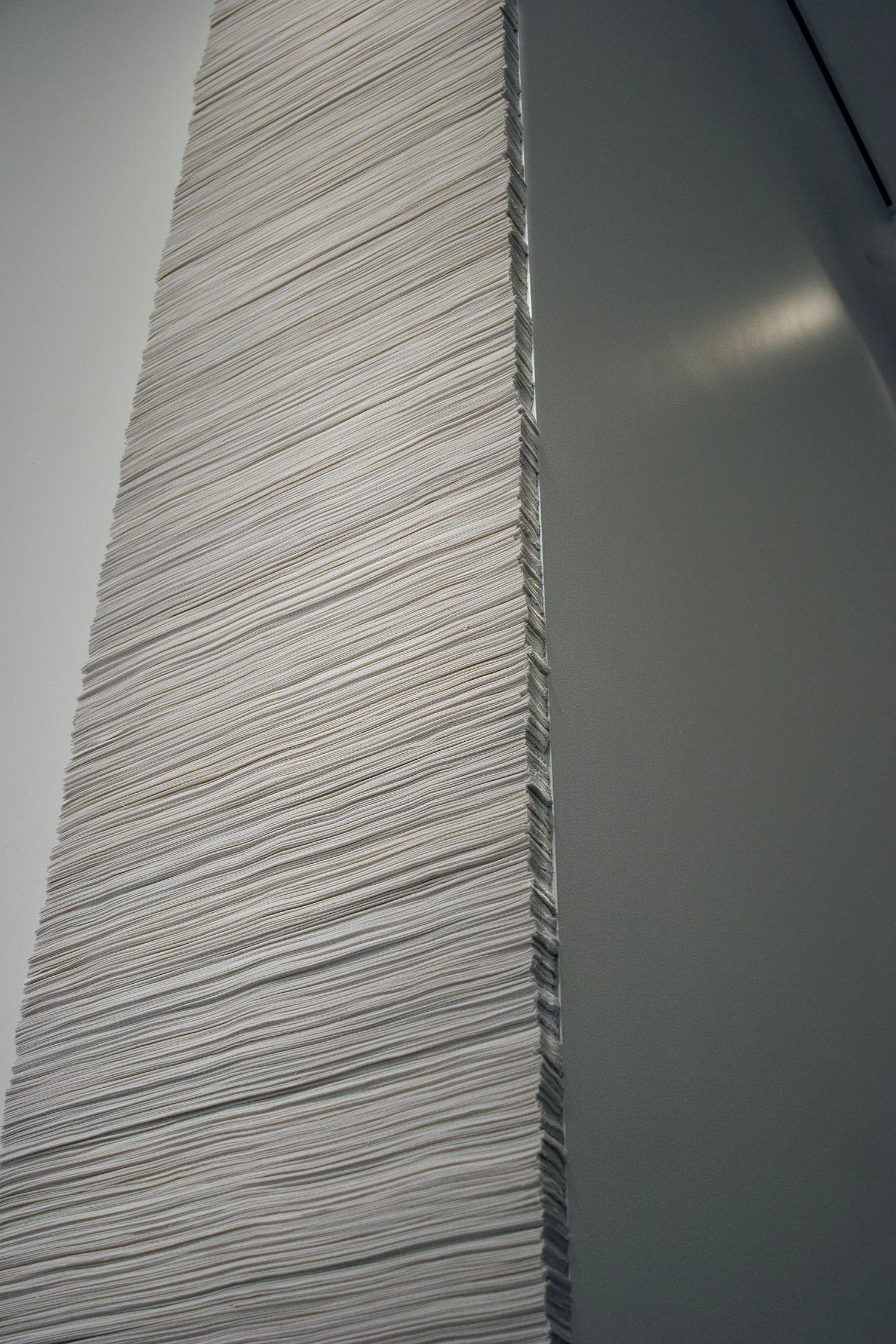
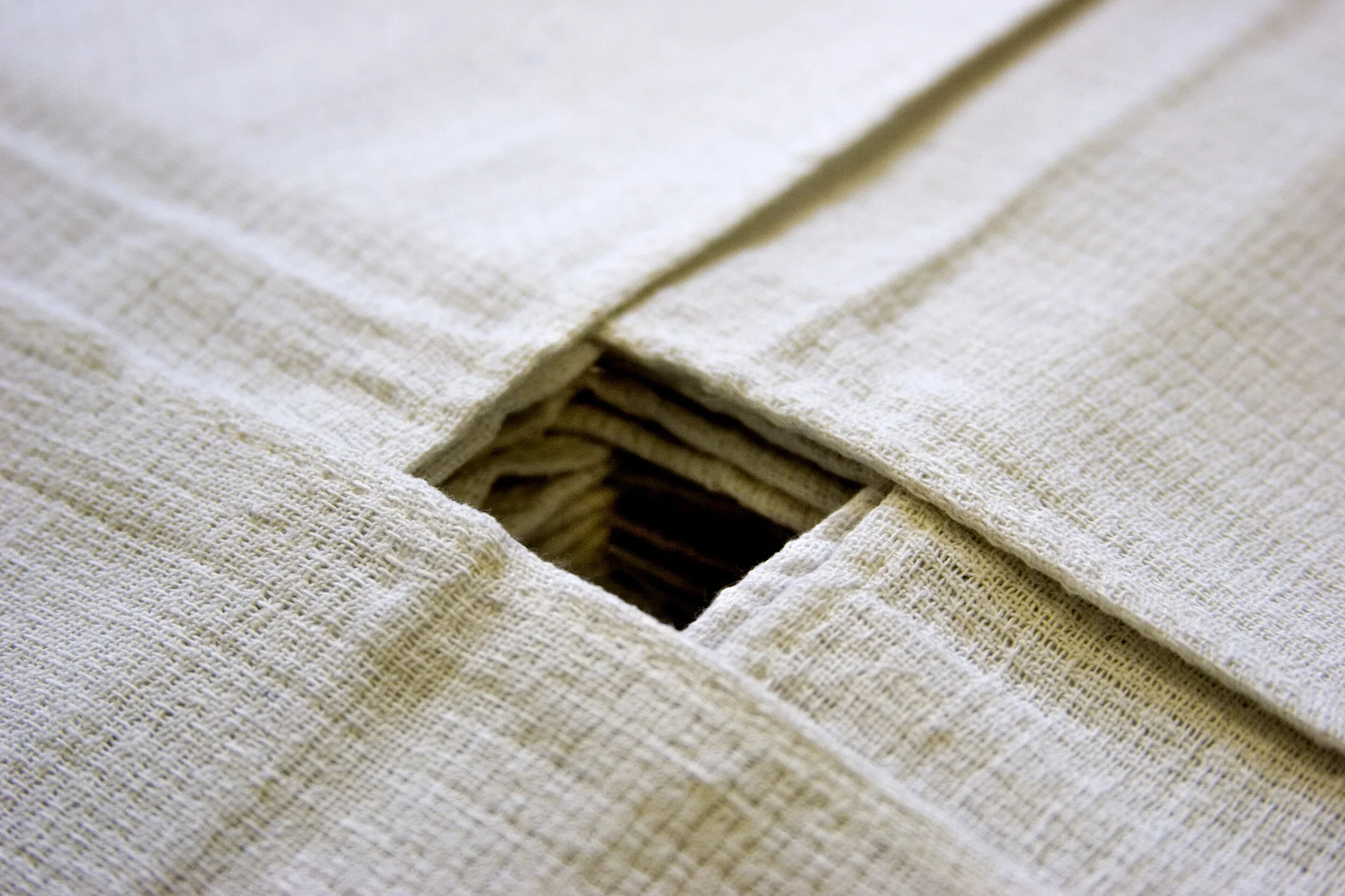
Image caption: Edge detail from foldoverfold, Kemper Museum of Contemporary Art. Photo E. G. Schempf.
The trouble with the mud towels is that they represent a closed system, and I suspect that Gross was wary of them as portable objects. They form a sort of cul-de-sac in the broader line of inquiry that drives an artist like Gross, and their success as objects might have seemed counterintuitive. Prior to towels, Gross had been working with newspapers and paper bags. These investigations had led her to remote locations where she stacked them and left them to rot, documenting their deterioration, sometimes retrieving them to show. In this context, the mud towels introduced a poetic exchange of ideas, really, bringing the earth, site, to the towels.
As provocative as they were as objects, the mud towels were simply the opening salvo of an artist in transition and in search of higher ground, in Gross’s own words, “a place where it connects.” Metaphysically, Gross had already moved beyond the tyranny of objecthood with the bag and newspaper projects into more complex relationships of site and time, displacement and representation. I realize I’ve whipped out the term objecthood rather blithely here, like reaching into a top hat for a rabbit and pulling out a Rottweiler. I’m thinking about the object here in an ordinary sense as a consumable thing that lacks locational identity among its various properties. There was a natural segue between paper and fabric in terms of material histories and process, folding and stacking, although it was a theoretical gambit. In corporate terms, taking on towels was a lateral move, and it involved a measure of backtracking and formal reiteration in the hopes that she could push her ideas further in the new medium.
There were many mudless towels to come, tens of thousands in fact, and many reconsiderations of form and material and process before Gross could or would be able to compile these elements into a site-based work as thorough and convincing as the foldoverfold exhibit at the Kemper.
This is what I like about Gross’s towel work: the patience of it. Not simply the mechanical narrative, the folding, the stacking, but the overall momentum of the work and its internal resistance to its own success. This is the sort of thing that might elude the casual observer of foldoverfold, “Oh, towels again …” and has to a certain extent eluded critics over the years. Gross is a site-based artist at heart, not an object artist.
I don’t mean to suggest that previous critical readings of Gross’s towel work have been offline or even out of step with Gross’s own self-characterizations. Maybe just a bit near-sighted. Alice Thorson of the Kansas City Star has consistently championed Gross’s work in the more poetic traditions of Minimalism and Post-Minimalism and rightly so. Objectively speaking, most of Gross’s towel work finds its bearing somewhere in this vicinity. Not in any imperious or ironic fashion but conversationally, the way music emerges from other music.
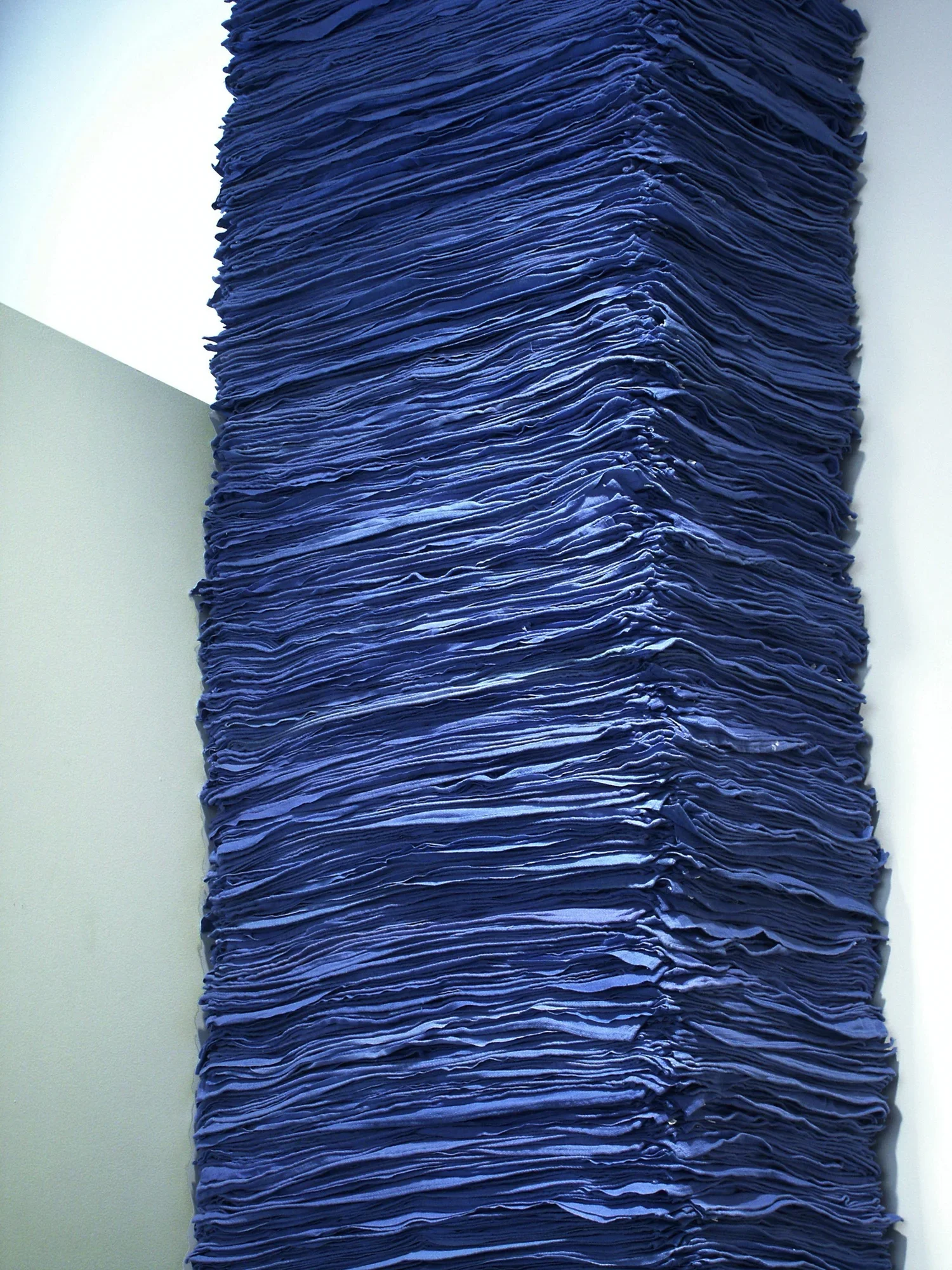
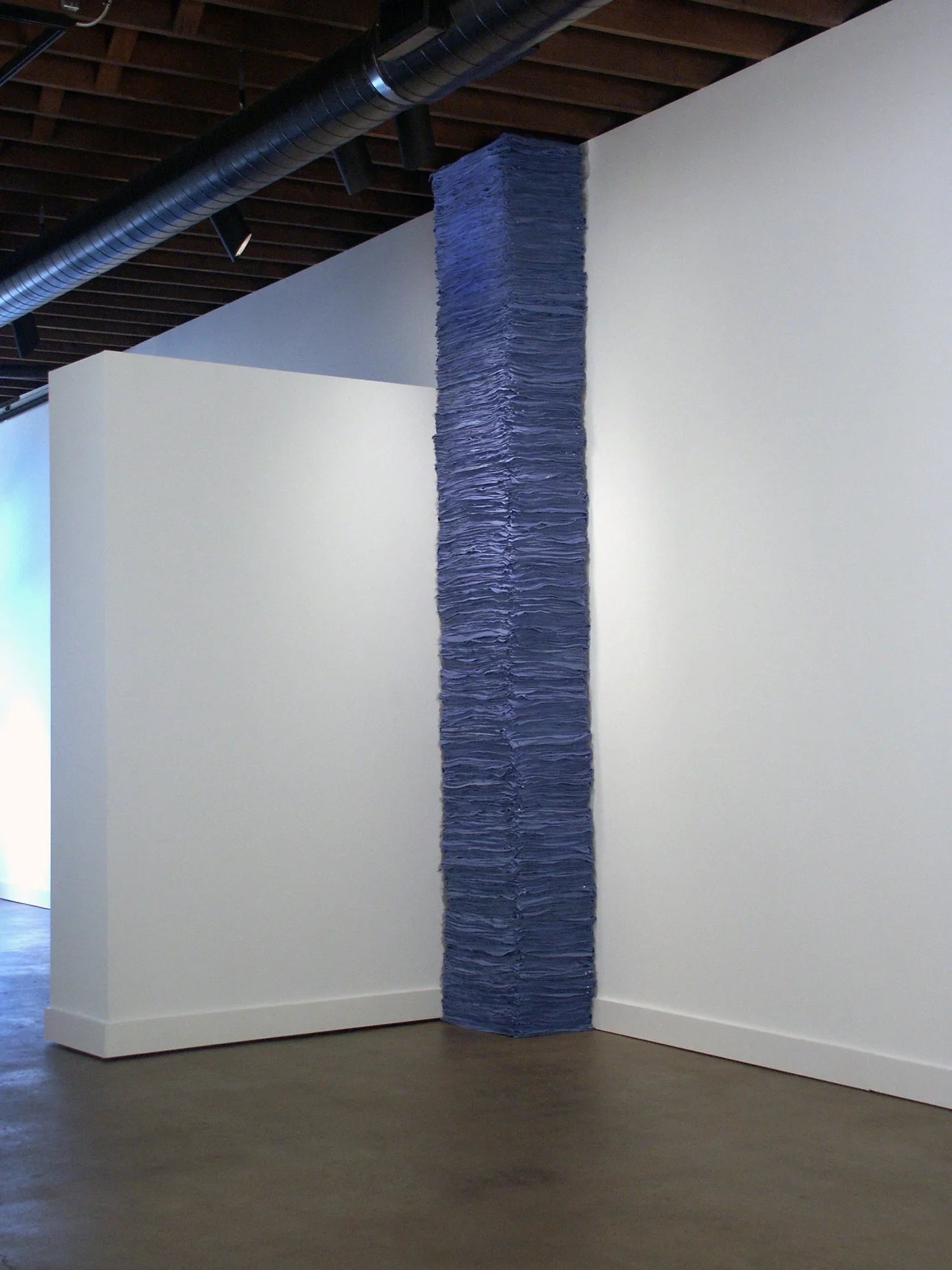
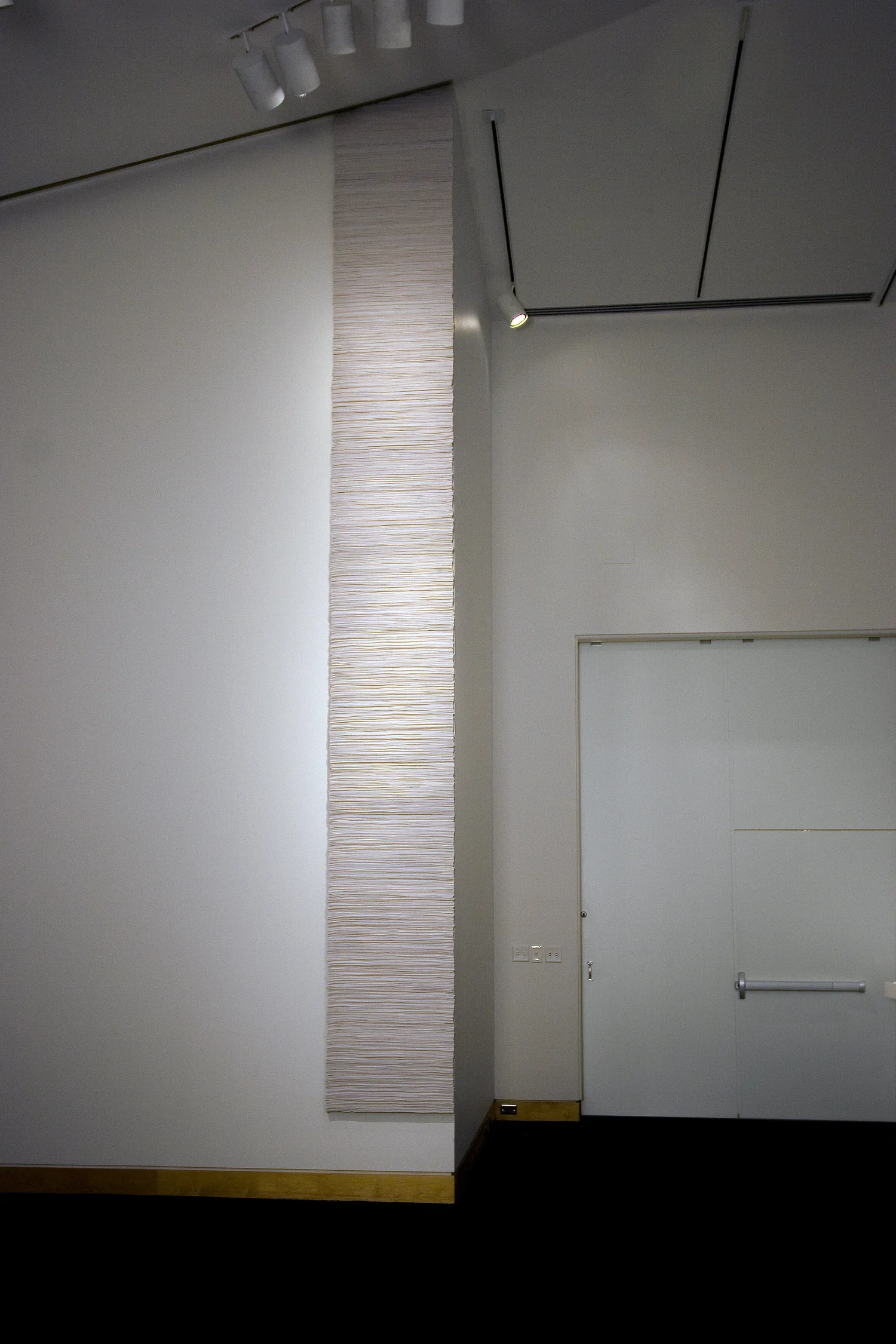
Gross’s wall piece, Compress #2, and the floor-to-ceiling Axis, both from 2003, openly employ the serial formality of Donald Judd minus the austerity of Judd’s prefabricated universe. Gross reverses the so-called Minimalist field, particularly with pieces like Axis, capturing the architectural sense of Judd without pushing the viewer away. Judd’s iconoclad forms of metal and plastic purposefully polarize the human space they occupy, as if each one were a bomb that might explode at any moment. They activate space and arouse our sense of scale in large part by setting our ego ablaze. Gross’s forms share a similar geometry, but their assertions are ego-less; their hand-built nature and material defects discharge the space around them to create an interchangeable sense of scale, at once physical and emotional.
This point is interesting because it has opened Gross’s work up to all manner of critical seduction. Kate Hackman, reviewing Gross’s solo show at the Joseph Nease Gallery in 2003, went so far as to describe the aforementioned Axis as “a pillar of faith for the secular world” and “a return to the core of our beings … .” As much as I admire the passion behind these statements, and the eloquence of the review in general, they do less to decode the work than they do to decode Kate Hackman. If anything, they quarantine the work unnecessarily. There’s just not much left to think or feel or say about a work that represents the core of my being. It’s the rabbit hole.
On the other hand, Hackman recovers nicely in the end with a longer view of things: “… Gross adroitly taps a point where form becomes content, where there is no longer a separation between what our bodies sense and what our minds deduce.” I can get behind this statement because it puts Gross back in the ballpark with Judd, and Richard Serra, Agnes Martin, Carl Andre, and Barry Le Va, and the more contemporary company of Rachel Whiteread and Soledad Arias, all of whom would claim the same, and none of whom would profess to summarizing the human condition. If anything they, like Gross, inhabit a realm of inquiry that strives to reveal a world that still holds the possibility of a human condition.
Last summer, I visited the DIA:Beacon in Beacon, New York. About an hour’s train ride north of Manhattan, the DIA:Beacon is a capstone of 20th century museumship. More mausoleum than museum, it provides a lavish resting place for a lucky contingent of predominantly white, male and American artists of the 1960’s and 70’s avant-garde, some dead, some not.
Setting aside the politics of selection, the DIA:Beacon tests an extraordinary hypothesis, not unlike the puzzle of Schrodinger’s Cat: If a museum contains art that calls into question the museum itself, is the museum still a museum, and if so, is the art still art? The answer of course is yes, and no.
Historically, the DIA Foundation has sought to support and help maintain the work of artists working outside the museum framework. Credits include Walter De Maria’s Lightning Field in New Mexico and The Dan Flavin Art Institute on Long Island, as well as associations with Michael Heizer’s City complex, James Turrell’s Roden Crater, and Robert Smithson’s Spiral Jetty. A surge of investment came to the DIA Foundation in the late 1990’s, primarily in the form of bookstore mogul Lenny Riggio, founder of Barnes & Noble. This resulted in the multi-million dollar overhaul of an old biscuit factory on the Hudson River and the establishment of DIA: Beacon.
Image caption: Axis, from the Joseph Nease Gallery exhibition in 2003. Photo E. G. Schempf.
The notion behind it essentially turns the foundation’s original mission on its head. Rather than providing artists the means to a site, it has provided a site to the means of a couple dozen artists. Robert Ryman, Michael Heizer, Walter De Maria, Dan Flavin, Fred Sandback, Sol Lewitt, Donald Judd, Bruce Nauman, Richard Serra, John Chamberlain, Joseph Beuys, and, oddly, Andy Warhol are among those accorded enormous square footage in the service of exhibiting their work in the way that, perhaps, it is actually meant to be seen. This, in and of itself, is a remarkable achievement. The sheer scale of the place and the way it is designed to extract every last volt in the differential between what is there and what can be seen there is staggering. And yet, for all its theatrical success, I left there with something similar to a hangover, a distinct feeling of unreality.
While there are some real things there, Richard Serra’s Torqued Spirals alone are worth the price of admission, the DIA:Beacon is a beautifully staged reconstruction of bygone urgency. Ryman’s re-taped paintings, Beuys’ restaged I Like America and America Likes Me, Heizer’s resuscitated North, East, South, West, Lewitt’s wall drawings revisited, the list goes on, these are not art. They are prosthetic devices that remind us of art. In the end, the DIA:Beacon best resembles a place described by Miwon Kwon, One Place After Another, page 38, where “active processes are transformed into inert art objects once again. In this way, site-specific art comes to represent criticality rather than performing it.” In short, a museum. All of which proves you can take art to the site, but you can’t put the site back into art. I say this, however, only from the dubious standpoint of a mere observer. As in the case of Schrodinger’s Cat, if you never lift the lid on the DIA:Beacon, rest assured that there is still a 50/50 chance that the art there is still art!
In a vague sense, all art is site-based, even traditional works of painting and sculpture. I mean, everything is somewhere, yes? But more often than not, the importance of site is taken for granted and subjugated to the necessity of exhibiting and selling work. Most of the time, when we think about site-specific art we think of something renegade, something outside the confines of convention. So, it isn’t that common that you see or recognize a gallery show like Gross’s foldoverfold that actually recontextualizes an artist’s work and flips the switch from object to site and back again.
Foldoverfold is not an act of salesmanship, nor does it recant its inheritance. Instead, it serves as Gross’s best opportunity to date to consolidate and carry forward those previously prized developmental concerns of material awareness, formal elegance, and process, object lessons, into an expanded and dedicated dialogue with the physical and theoretical realities of site.
Looking back, you can see the arc of this dialogue forming in her shows at Joseph Nease, and even in the single works she created for group shows like the Charlotte Street Fund Exhibition of 2002, and the Flex Storage Systems installation in Topeka, in 2004. The Kemper, however, offered Gross an unfettered and uninterrupted venue in the Barbara Uhlman Gallery.
Working from a scale model of the gallery in her studio, Gross created three simple elements to engage the space: Rotation, two low-lying modular floor stacks set off-kilter toward the unknown center of the room; Intersection, two planar wall stacks level at the top, one grounded, one floating, squared off like a brace in the northeast corner of the room where the ceiling plunges toward the earth; and Edge, a sleek, narrow column of cut towels that seemed to move down rather than up the edge of the towering entryway, suspended as it was just a cut above the floor.
If you traveled the eye down from the top of the Edge across the floor to Rotation and then up and back out of Intersection, there was relief from the angular dysfunction of the room. It’s an uncomfortable space, like an attic room with no windows or a giant walk-in closet. You want to keep looking back to make sure there’s a way out. Gross alleviated this fear by setting up simple X, Y, Z coordinates, a Mel Bochner-esque means of escape that made it okay to stay. To experience time there.
Understanding the unity of the work and the reconfiguration of space is crucial to the success or failure of foldoverfold. You can say whatever you want about the individual elements in the show, the nature of the towels, or the function of the museum itself as just another sort of storage facility, and you might be on to something. You might find sanctuary amid the subtle pulse of white towels on white walls on gray carpet or in the baffled silence that can only be the sound of five thousand towels at rest. You might consider the time it took to fold them and arrange them and where they might have ended up if not here? You might notice the wry corruption of each towel against the geometry imposed upon it and be reminded of the patterns of disorder we try so hard to hold in check.
This is the apparatus of emotional scale, the things we attach to the work, and it all hangs in the balance of the work’s physical unity and scale and the armature of location. None of it will survive intact beyond the physical boundaries of the room itself. Such is the fate of an art that resists its own success and yields to the passage of time. It marks the distinction between work that is important and work that is merely interesting.
Down the hall from the foldoverfold, in the main gallery, was the group show, Decelerate. I wandered over. I read the statement about our hectic lives and the new art herein that might save us all from becoming high-speed junkies. I peeked in. It looked like a haunted house, too much stuff, too many people, too many guards. I went back to foldoverfold. It was a better place to hide. An inside job, and a job well done.
Marcie Miller Gross is a Review Studios artist.