Review: To Fold
By: Kate Hackman
May 2002
Sculpture, Review Inc.
Kansas City, MO
Marcie Miller Gross
Joseph Nease Gallery
Marcie Miller Gross, Trace, 2001. Used bath and hand towels, washcloths, earth, and plaster, dimensions variable.
Marcie Miller Gross’s “To Fold” opened three days after the attacks on the Pentagon and World Trade Center. For a public seeking to grasp and mourn the horrific events, her installations of used towels - either hospital white or caked in mud; folded, stacked, and placed on long shelves or benches - felt stunningly appropriate, even prescient. The meticulously ordered environment was sanctuary-like: neatly aligned rows of spare wooden benches read as pews, and bare walls implied the absence of means to convey the magnitude of such tragedy. The juxtaposition of stacks of muddied towels and piles of crisp white ones spoke of ruin and rescue - of bodies lost amid rubble, others pulled to safety - and of laborious clean-up efforts rendered in attempt to restore some semblance of “normalcy” to chaos. Even bleached towels revealed blood and urine stains, reminding one of the endless cycle of life and death.
Though current affairs invariably informed one’s viewing, Gross’s work invited multiple interpretations. Using the towel as a repeating unit, the basic building block composed of four distinct pieces, she engaged the formal language of Minimalism yet challenged its cool remove by substituting pliant, absorbent cloth for hard-edged, industrial materials. Gross’s work derives power from functional connotations, invoking domesticity, intimacy, the “feminine,” and the human body, as discolorations and frayed edges testified to a history of use.
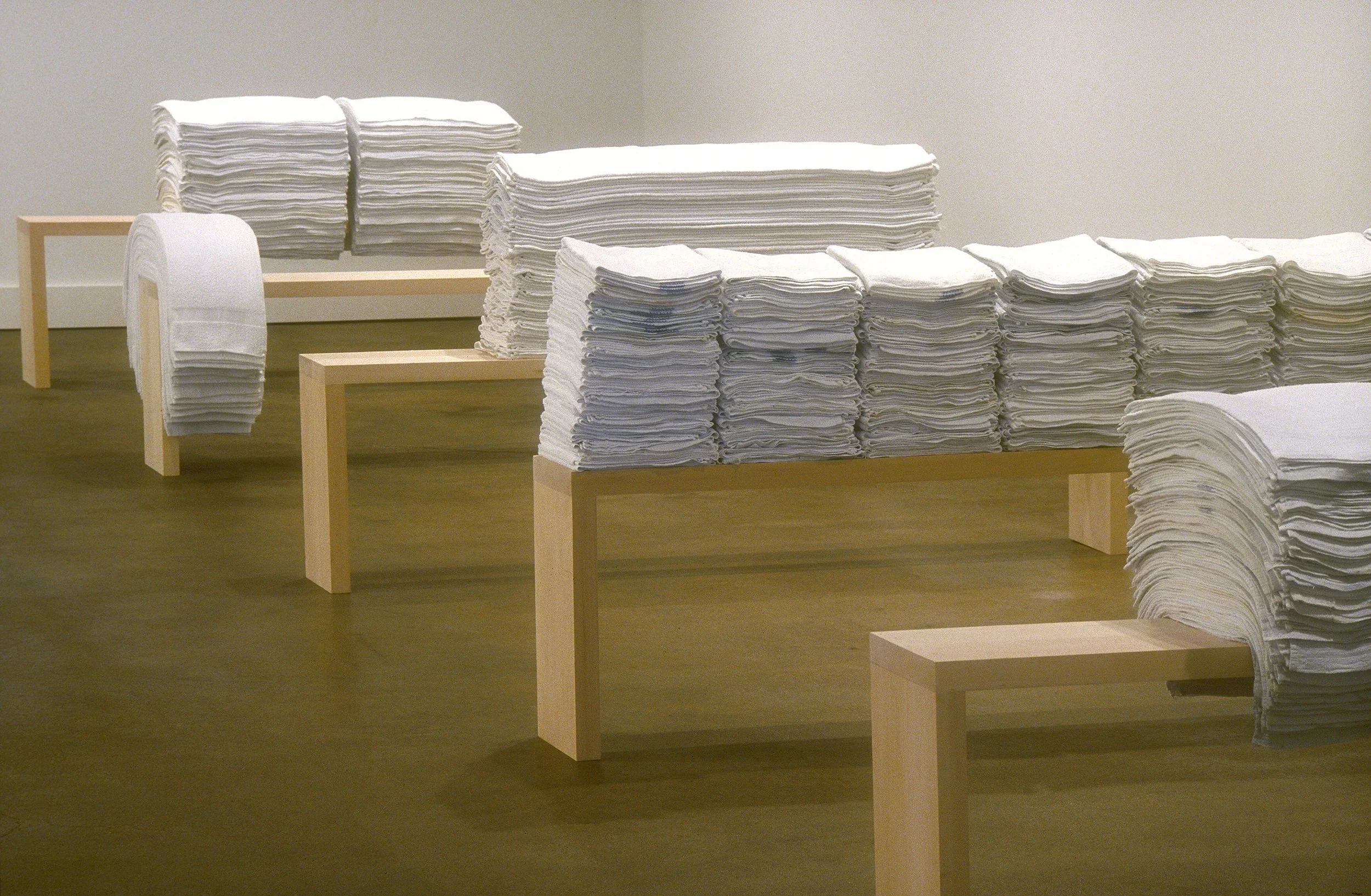
Marcie Miller Gross, Accretion: Divide, Separate, Balance, Fold, Stack, 2001. Used hospital towels and wood, each part approximately 72 x 9.5 x 32 in
One of two installations in the show, Accretion included five identical benches of blond wood, each supporting dozens of white hospital towels arranged in crisply folded piles. Titles of individual components - Divide, Separate, Balance, Fold, and Stack - referred to the methodical process. (Separate, for example, featured two piles, placed at far ends of the bench, each folded several times lengthwise. Occupying minimal surface area, the stacks seemed to shrink away from one other, exquisitely exemplifying the notion of separation.) With Accretion Gross most fully achieved a powerful balance between formal tightness and potency of meaning. The perfectly aligned edges, soft bulk, and gracefully fanning ends of the bleached linens against the simple geometry of the benches was both visually stunning and viscerally satisfying, evoking a spa’s promise of luxurious care. Simultaneously, each of the five components resonated metaphorically, exemplifying a psychological state or interpersonal dynamic, as the materials’ bodily associations cast them as human surrogates. This effect was furthered by yellow and red stains, discovered on closer inspection, which established each unit as a unique, intimate document, laden with the residue of past wounds and attempted nurture.
Trace, Gross’s second large installation, extended along one long wall, traversing the divide between two adjoining gallery spaces. Its low wooden shelf bore a variety of folded, mud-encrusted bath towels and wash cloths, displayed singly or in short stacks. Additional towels, suspended a few inches out from the wall above, corresponded to empty stretches on the shelf, creating an overall rhythmic syncopation. Again playing on a Minimalist aesthetic, Gross arranged the cloths in grids or rows, most immediately recalling the look of high-end retail display. More subtly, the towels of various sizes, shapes, and textures, separated by gaps, seemed to assume familial groupings - a couple with one child here, four sisters there. This sense of life, growth, and community was compounded by the floral relief patterns of some towels; saturated with crusty mud, they suggested a sort of conceptual garden, as earthy associations mingled with pristine construction.
Complementing the installations were two smaller works. Endure is a well-worn, white-painted wooden chair supporting a voluptuous stack of mud- and plaster-encrusted towels. Folded so as to become progressively smaller toward the top and positioned while still wet, the pile echoed the curves of the seat and the slats of the chair-back, suggesting a slouching body, molded to the contours of its support. Incorporating soil dug from Gross’s family farm, the piece allied environmental nurture with physical form. An Untitled companion piece provided a more precarious counterpoint. A low, crickety blue stool seemed on the verge of collapse under the weight of a tall tower of towels, which itself seemed poised to topple. If Endure captured a grandmother’s gentle embrace, this piece evoked a tired mother, hunched beneath ceaseless piles of clutter.
A 1990 graduate of the Cranbrook Academy, MFA in sculpture, and lecturer at the Kansas City Art Institute, Gross has consistently incorporated organic materials and repetitive processes into her work. With “To Fold,” she asserted an increasing ability to explore a range of ideas through highly controlled means. The exhibition’s appropriateness to the current moment was a product of her honest approach and grounded interest in the emotional, psychological, and physical associations of objects whose very fabric bears evidence of time, process, use, and care.