Spatial relationships are focus of ‘Concentrations' at Studios Inc.
Exhibit of 2-D works reveals artists’ 3-D work
By: Dana Self
Special to the Star
05 October 2011
In her show "Concentrations," Marcie Miller Gross works almost exclusively with heavy gray felt.
If patience is a virtue, then Marcie Miller Gross and her audience should be handsomely rewarded.
Gross' work is a study in stamina and the subtle delight that a tidy, orderly world manifests.
In this show at Studios Inc.'s exhibition space, where she's been a resident artist for several years, Gross' industrial gray felt installation is a fitting companion to the gallery.
The gray floors, walls, and ceilings in this voluminous space are oppressive, and here Gross' immaculate fiber work actually seems to lift the space, to suggest its rightness as a gallery.
While working almost exclusively in gray felt for this exhibition, Gross does include several minimalist drawings and some works incorporating lush, creamy-white felt and white military blankets.
In "Working Parts (wedges, blocks, slabs)," we are led through a field of felt and wood objects displayed on a long table. These components embody Gross' ongoing interest in opposites: mass/void, large/small, soft/hard and absence/presence.
In her larger wall pieces, the dominant gray felt squares, rectangles and other hard right angles shape our experience of the gallery and the relationship of each work to the other.
Heavy gray felt inevitably suggests German artist Joseph Beuys' work. Beuys prized the material for its ordinariness, the warmth that felt provides, its flexibility and its personal mythology.
Gross, on the other hand, revels in the material as a measure of spatial relationships rather than for its more liquid effects, configuring it into grids and patterns. The pieces are methodical, balanced and severe in their restraint and reliance on relational proportions.
She cuts the felt on a variety of band saw blades, causing tufts in the fiber that she exploits for their surprisingly mammalian effects.
Gross works these tufts into furry ridges that suggest human hair or animal fur. The tufted gray felt adds a gentle humanity to Gross' sedate and overtly formal explorations of space and geometry and softens the edges of "Sheared #2 (shift)" and "Sheared #1 (alternating)."
"Untitled (blankets)" is the most animate and anomalous of Gross' quiet work in this exhibition. Stacked four deep and softly draped over the edge of a shelf, the blankets suggest comfort and presence, or at least the presence of absence.
The blankets offer a sensual and sensory moment in an otherwise rigid exhibition defined by tight organization, right angles and measured spaces.
While Gross' work, in some aspects, may remind us of Ohio artist Ann Hamilton's monumentally expansive installations and fiber's vast possibilities, Gross' work is, instead, an accumulation of smaller moments, movements and relationships.
But just when you think that Gross' work is too austere, she smartly produces subtle touches in the pieces that bring us back to our physical selves and our infinite and essential relationship to fiber. How do we measure labor and its value? Globalized industry assigns a number or a mathematical weight per hour, unknown to consumers in far-flung countries. Wool sweaters made in the tropics are inventory, not local necessity. Their making is not for bodily protection, but it does connect to survival. Do we then subtract value when the making of sweaters is undone by another labor?
The first impression of Marcie Miller Gross’s work is that as contemporary Minimalist sculpture, it owes a large debt to Donald Judd. In Flex (line), a horizontal box hangs at eye level, and the size is quite similar to that of Judd’s work. Yet within the restrictive geometry, there is an aesthetic of compassion in sharp contrast to the cool elimination of content and craft posited by Minimalism. To do the math is to add labor and cloth into the equation.
One reference for expressive meaning is Gross’s choice of material: discarded wool sweaters. Cast-off clothing has many potential attachments, psychological and physical. Any pathos is erased in the sweater’s new role as an inventory of parts. Sleeves are separated from torsos, which are cut methodically into narrow strips. In Flex (cube) and Flex (line), the strips are stacked and cut again, reconfigured into compressed blocks of geometric color and softly shifting pattern. The modulated palette is determined by the accumulation of fashion choices over many years, realigned in a checkerboard that will not snap tight to the grid. The felting of the sweaters prior to their disassembly renders them more absorbant and able to be compressed with a particular weight and density. These works transform the sweaters into abstract geometric volume while retaining their material identity, as the slight protrusions and non-conforming angles of knit undulations create the mathematical rhythm of a musical score.
In Inventory, the sweaters’ striped or Fair Isle-patterned identities are revised into narrow strips grouped from pins across a strong top horizontal line. The 45-foot work gathers another musical reference in its ordered sections: sweater strips form the ebony increments of a piano keyboard and the negative space of the white wall creates the ivories. This system loosens to organic lines of seams cut free from sweater mass, revealing an architecture of the body even when collapsed. As the dissected garments hang from a single point, gravity does not diminish their human quality, and with it the separate identities of original maker, wearer, and now artist. The aesthetic skill required to transform the sweaters is less showy than traditional virtuosity. In this, Gross calmly asserts the value of human labor and knowledge that must be shown.
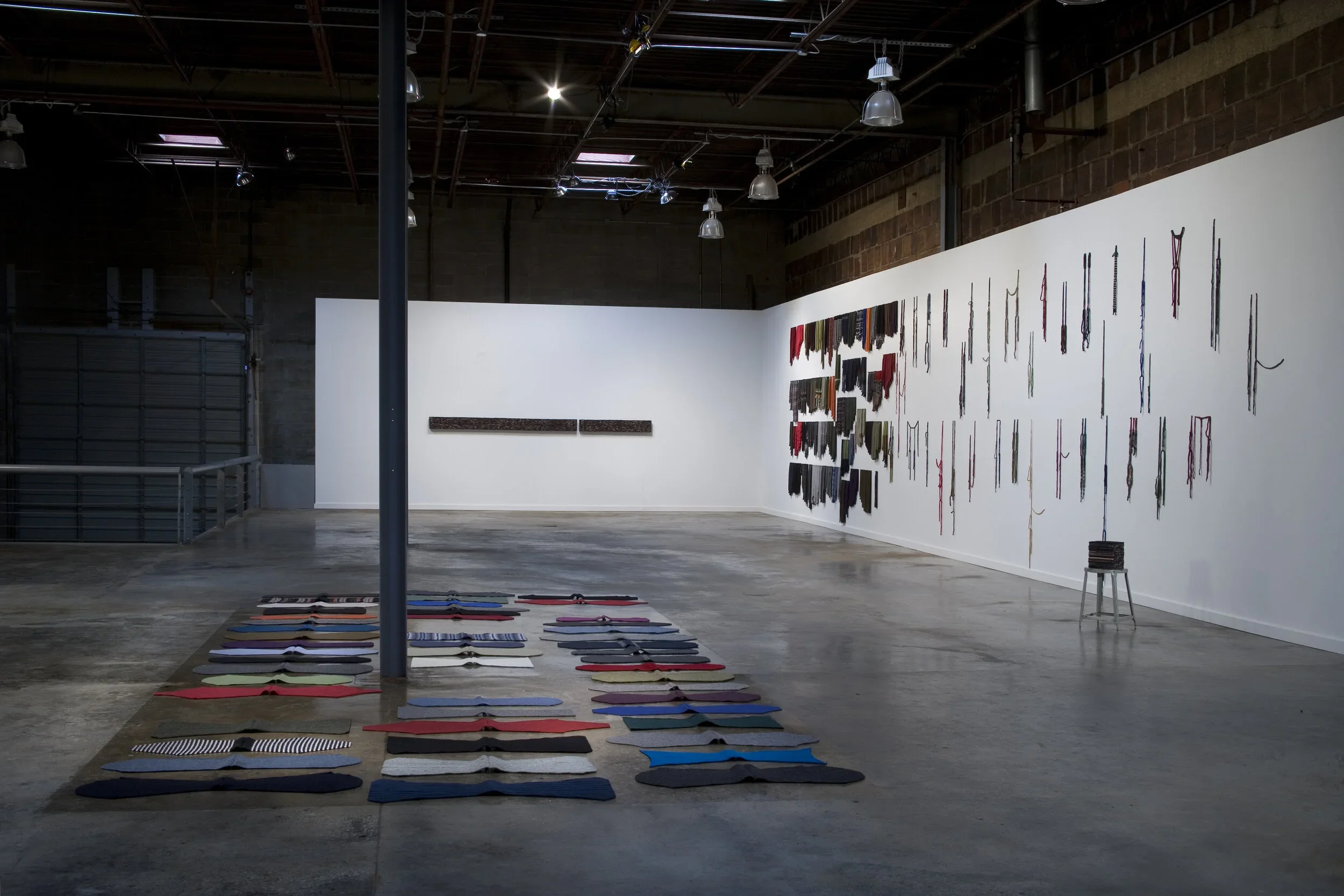
Marcie Miller Gross, installation view with Re-pair, Flex (line), Inventory, and Flex (cube), 2008. Used felted wool sweater parts, pins, and found stool.
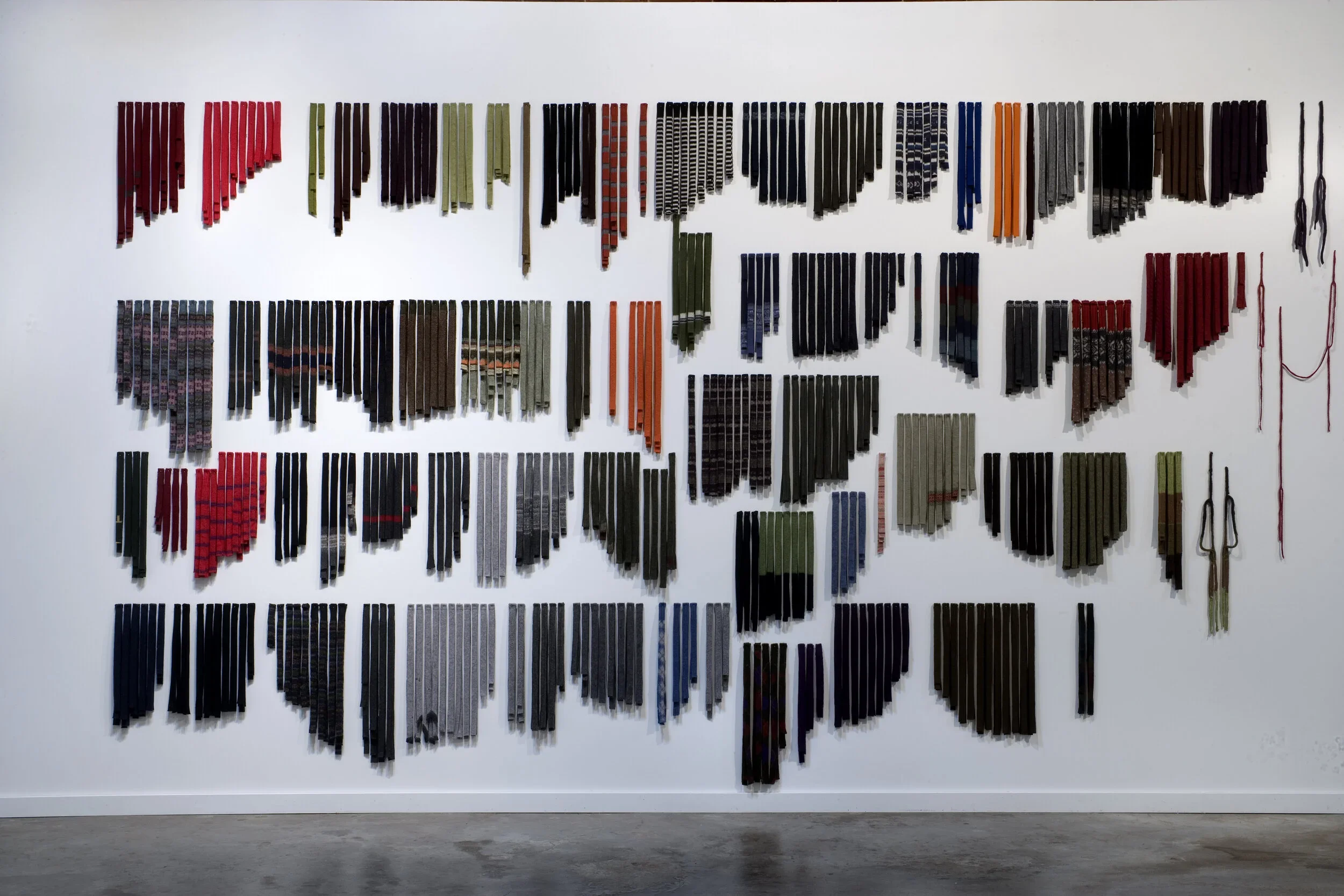
Marcie Miller Gross, Inventory detail, 2008. Used felted wool sweater parts and pins, 44.8 x 10.6 x .75 in.