Parallel Sites
By: David B. Olsen
2018
Haw Contemporary Crossroads
09.28 - 10.27.2018
Two trains leave the station at the same time in the same direction. We imagine parallel tracks in this case, because how else? Setting aside the improbability that they really leave at the “same” time, as Cratylus, student of Heraclitus, famously posited, one cannot step into the same river once, let alone twice, such wonderfully real-world math problems invite us to understand time and distance in terms of immutable relation. There is something at once romantic and tragic about the parallel as such. Parallel lines do not share a point; parallel planes will not meet. Without the possibility of intersection, the parallel is relation without reconciliation, lines locked in place, untouchable twins. The parallel is entirely dependent upon distance, but nothing in its definition accounts for the scope of that distance. Parallel lines could be a million miles apart. How would they even know that they were parallel, that somewhere out there they shared something with another?
It is in this interstitial, suspended place that we can first begin to think about the work of Marcie Miller Gross and Armin Mühsam, artist-neighbors with studios separated only by a hallway. Their studio building, located in the West Bottoms, Kansas City, is unshielded from the sound of passing trains, those low moans and shaky clackings of commerce in motion. Despite their evident formal differences, Miller Gross and Mühsam share a deep attention to the architecture of expression and to the inescapability of time, historical, art historical, personal, environmental, industrial. They are methodical artists who traffic in otherworldly reflections of the world as it is now, suffused with markers of the past and portents of that which will mark our future.
Their works are equally unpeopled, as it were, free of the figuration that would signify flesh in motion, but the profound stillness that they evoke is evidence of the utmost human care. For we, as humans, are on the move, but Miller Gross and Mühsam occupy a parallel in their unequal relationship to this passing of time. Their works speak to the atemporality and outside-time that attend the work of art as such. The duration of the art act. The purposeful, even painful consideration of placement. The alternating currents of deliberation and deferral, of intervention and letting be. Their shared language of architecture and accretion is an ancient one, echoing across eras, forms assembled meticulously, shapes giving way to structures.
It is no surprise, perhaps, that Miller Gross has turned to stacks of wool felt in her recent works. She has long favored the stack as an organizing principle of both her site-specific and her studio work, layering careful pillars of used surgical towels and sweaters, materials that testify to the ephemeral and momentary. A hospital stay, a chill in the air. Felt is one of the earliest known textiles, however, bearing the deep-time traces of experimentation and would-be perfection across millennia. Formed, in many cases, through the compression of tangled fibers, felt is a material that resolves a kind of disorder. As art historian Chris Thompson writes, felt “is a material enactment and embodiment of elements, tendencies, and forces that cohere most effectively because of, and not despite, the fact that not all strands have the capacity to connect with any or all others…. There is intimate space without each connecting with all, intimacy that exists because of, and not despite, the inability of each genuinely to connect with every other.”¹ The composition of felt relies on the intersection and collision of myriad fibers, and yet in this “inability of each genuinely to connect with every other,” there is the specter of the parallel line as well, that which is called into being precisely because it disallows junction.
In Miller Gross’s work, we are poised between felt’s ancient past and its most modern, industrial incarnation. Miller Gross achieves her strips and segments with a bandsaw, exerting influence over material that is otherwise willful and intent on its own shape, surprisingly resistant to the rectangular. These cuts rake and pull at the edges of the felt, and upon assembly these built forms often take on an almost singular, blurred surface. But still her creative act retains its primeval imperative, its past-ness. It is gestural, not industrial. We are reminded of the power of combination, even when that combination is not of collage, the assembly of difference, but rather an accumulation of that which is the same. This industrially produced material is transformed through deliberation and choice. The topographic exercise of each layer is especially evident in the works of green and cream felt on plywood shelves. The subtle vagary of Miller Gross’s structures at once contrasts and is amplified by the tight packing of the plywood itself, its parallel layers a paean to the precision of machines, to how perfect they can put things together. The relative disarray of the felt stacks is remarkably perceptible in this contrast. In one work, Shelf #2 (moss shear), three embankments of green slabs abut one another, ascending from the plywood base as though a bastion protecting something infinitesimally sacred.
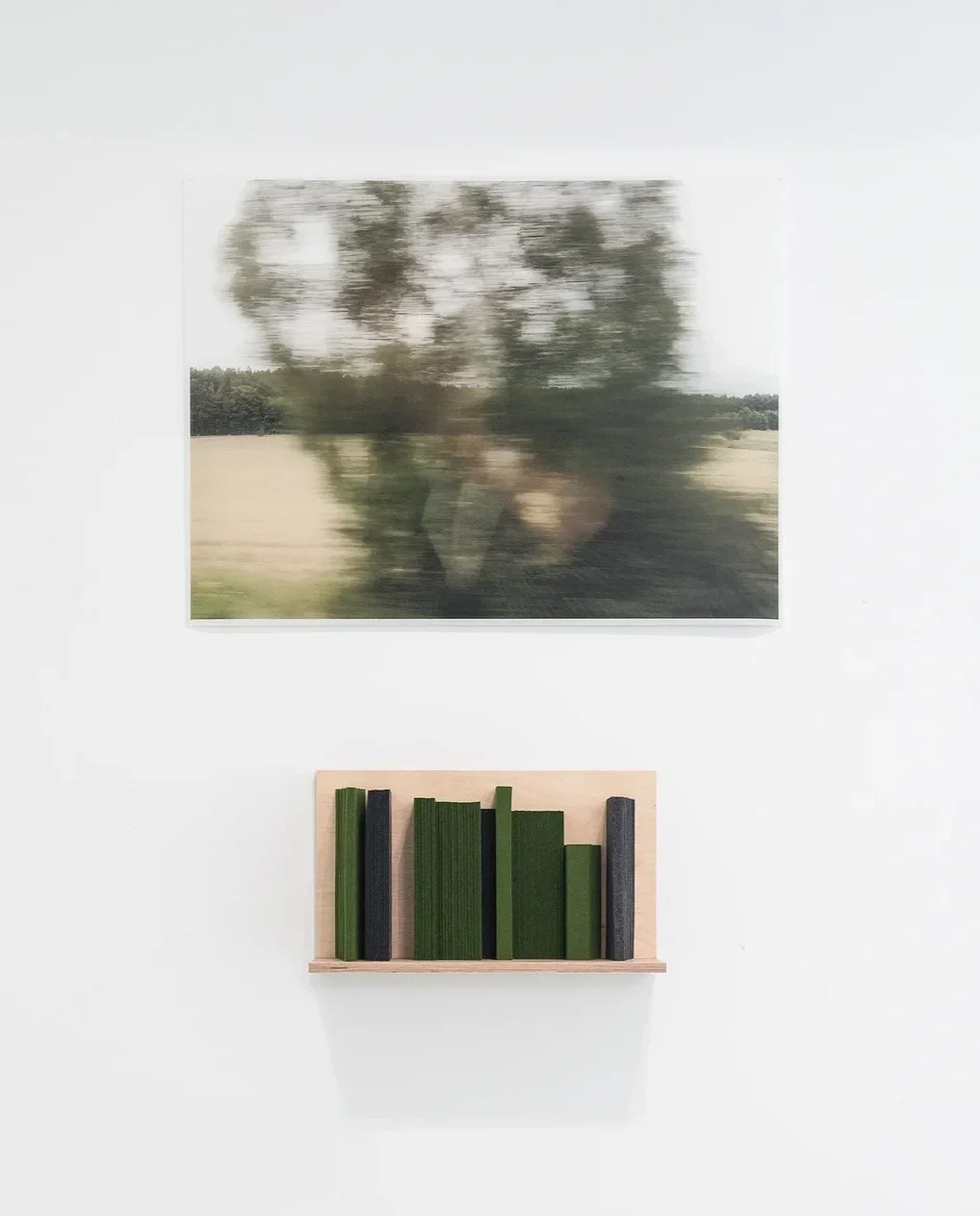
Image caption:
Marcie Miller Gross
To Spreewald, 2016
archival pigment print on matte film
31 x 42
Shelf #4 (grey moss), 2018
plywood, wool industrial felt
14 x 24 x 9”
¹ Chris Thompson, Felt: Fluxus, Joseph Beuys, and the Dalai Lama
Minneapolis: University of Minnesota Press, 2011, 30.
The act of looking inflects several of Miller Gross’s works in SiteParallels. Deliberate arrangements of felt sculptures on shelves are paired with photographic prints of all-but-amorphous landscapes. These are pictures that the artist took from a train just outside Berlin, and they record a certain impossibility in time. They are pictures of what we don’t see, calcified images of moments that should pass and have passed. And yet here we see what was nevertheless there at the right place and time. As Roland Barthes reminds us, just because “the Photograph is ‘modern,’ mingled with our noisiest everyday life, does not keep it from having an enigmatic point of inactuality, a strange stasis, the stasis of arrest.”² Miller Gross’s series of felt sculptures evolved from these photographs, and one sees in the raked edges of that felt a similar sense of the blurred, discrete elements reaching toward one another, aspiring to connection as time continues to fly by.
There is a sense of the memorial in Miller Gross’s work that eschews the grand, desperate-to-play-catch-up statements of American monuments in favor of the subtle ubiquity of those of Europe. Gazing at the ground there, one can learn without breaking stride that this was that, and that that was a long time ago. Miller Gross’s largest piece in the show, (2) Slabs, is a floor sculpture comprised of two planes of her compressed wool segments. The scale and placement would suggest the commemorative recognition of an event or a presence, something inscribed in the recordable past. One feels an out-of-focus art historical trace as well: Joseph Beuys, of course, Ann Hamilton, and perhaps even a kinship with Richard Serra’s 1969 Skullcracker series from the Kaiser Steel Corporation yard. There is something tectonic and beyond ancient about this work as well, planes coming together as though plates, colliding. However gentle the curve of the slope and the softness of the surface, there is an implicit violence, a crushing, a rising up.
Lowering yourself as parallel as possible to the floor, you’ll notice the small gap created where one plane overcomes the other in this work, a space that accommodates the upward curve without prescribing a presence to it. This is only one of the many points at which Miller Gross’s parallel with Armin Mühsam is pronounced, and it is a useful one. Mühsam’s most recent works on canvas articulate an array of forms that define space without recourse to the illusion of solidity. Created after a nearly two-year hiatus from canvas, during which he produced a series of sculptures and works on paper using a Czech art book on French Impressionism as the support, these new works depict accumulations of art objects in spaces that recall rarified stages for the presentation of art: galleries and villas, rooms with windows looking out unto a world of copses of trees. Yet there is an anxiety to these spaces. We are twice-removed from them as viewers of shapes to be viewed. An unseen force, although we know of course that it’s the canvas itself, amplifies our distance from the depicted. One feels the acute ominousness of certain works by de Chirico. Alternately, think David Hockney with a sturdier T-square, or, in Mühsam’s deliberate and exacting attention to abstract shape as such, a less ecstatic Tomma Abts.
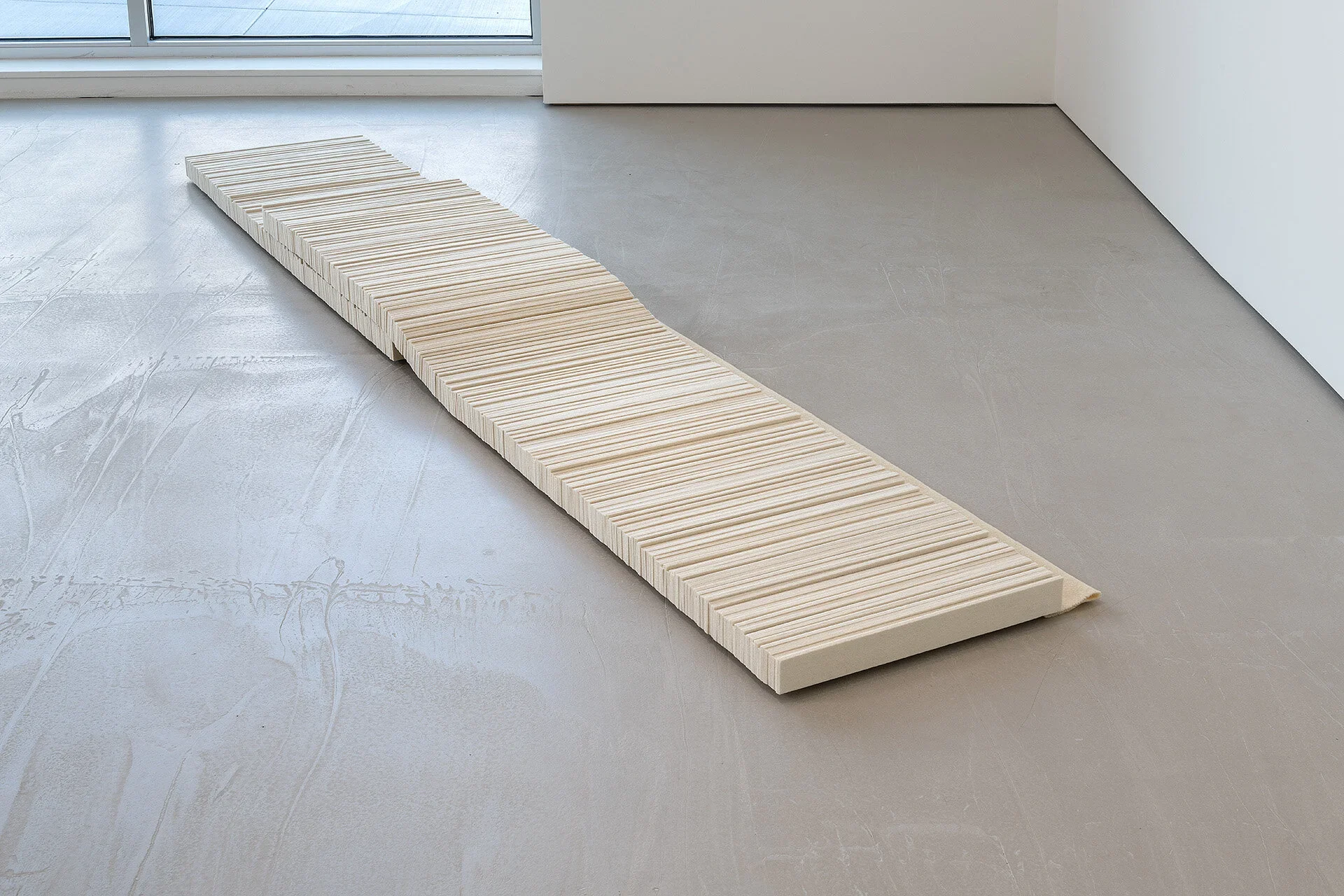
Image captions:
Marcie Miller Gross
(2) Slabs, 2018
wool industrial felt, wool blanket fragment
108 x 21 x 5”
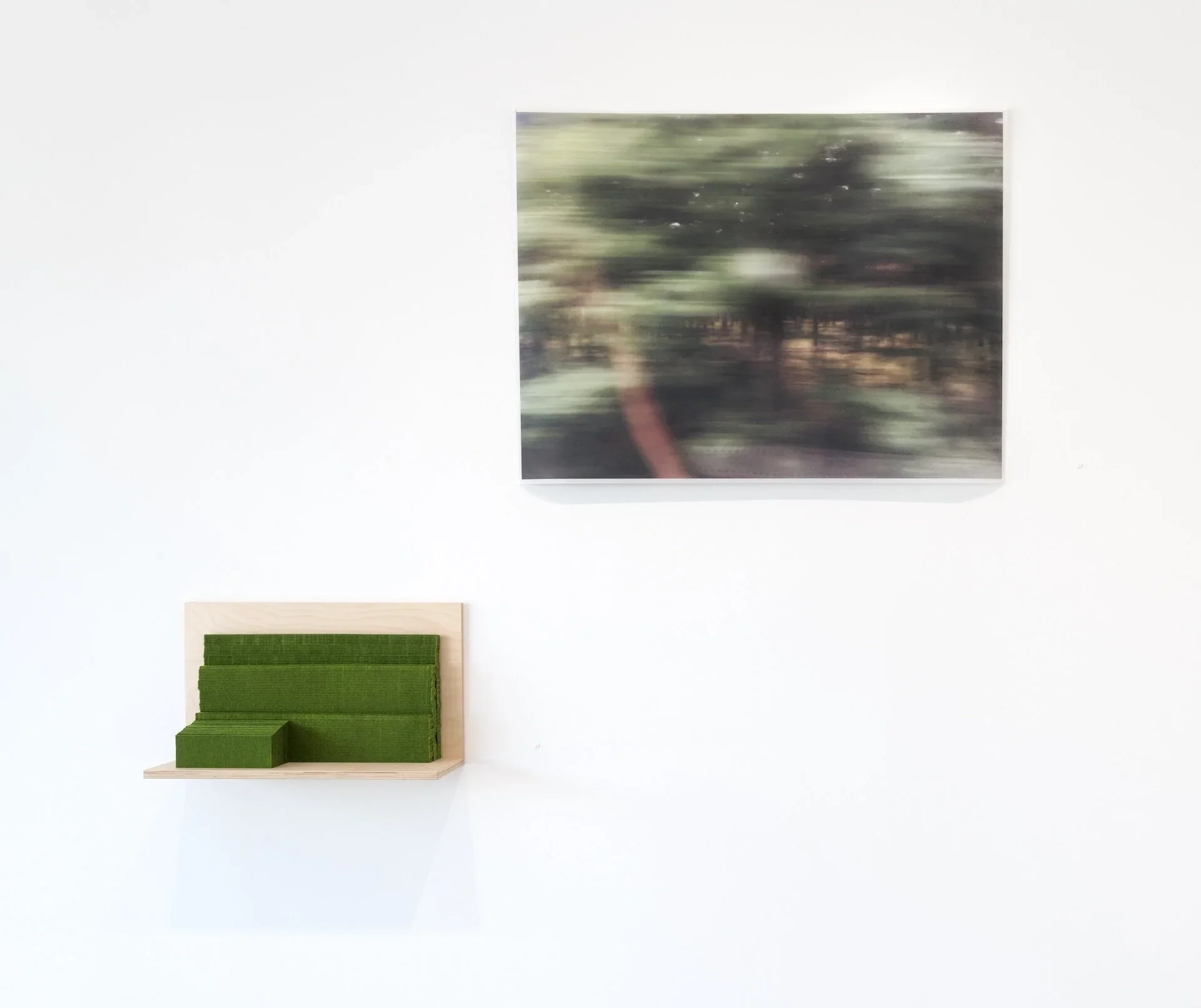
Shelf #2 (moss shear), 2018
plywood, wool industrial felt
14 x 24 x 9”
Through Woods, 2016
archival pigment print on matte film
31 x 42”
² Roland Barthes, Camera Lucida: Reflections on Photography, trans. Richard Howard
New York: Hill and Wang, 1981, 91.
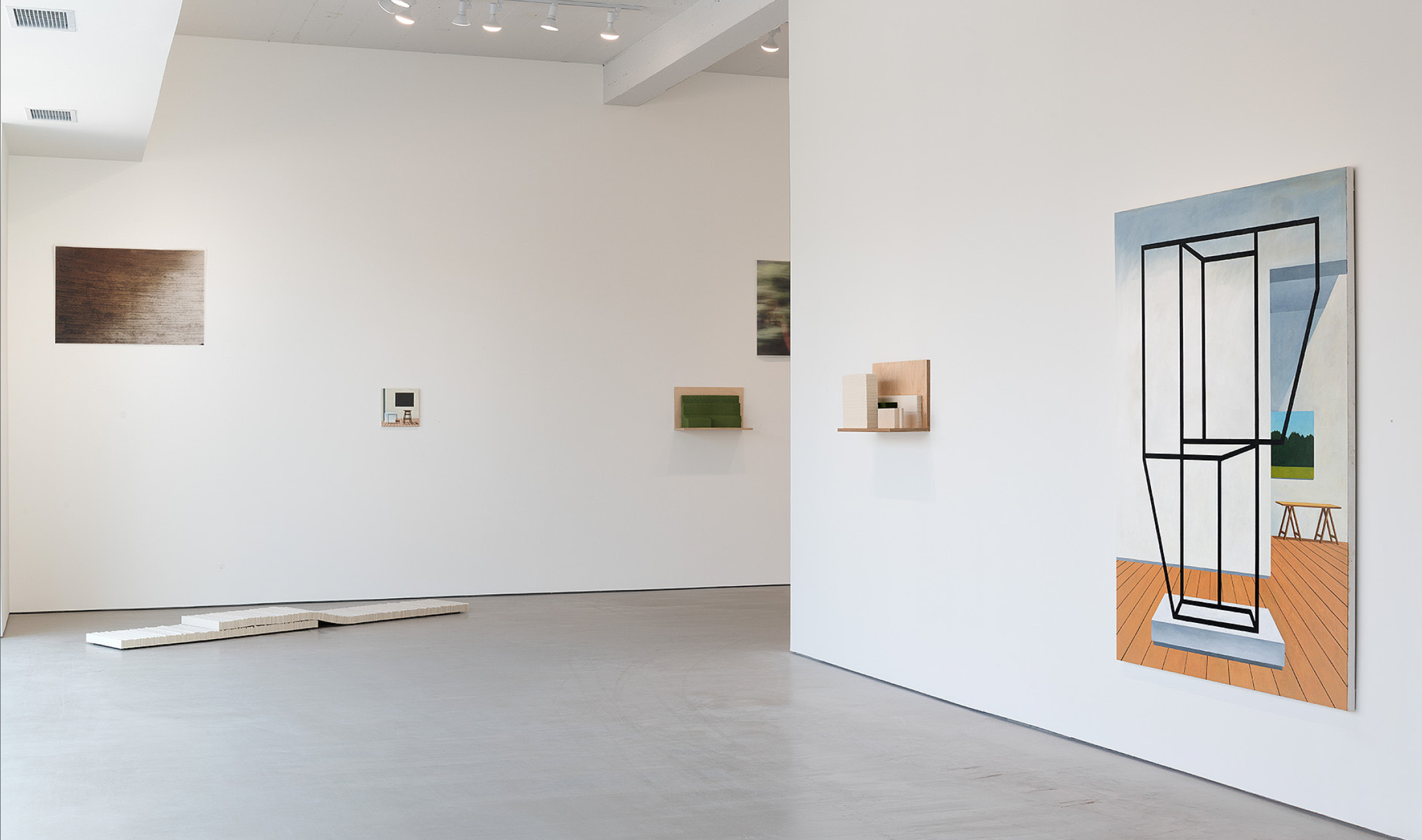
Installation View
Interior, Chapel Wall, (2) Slabs, Evolving Circumstances, Shelf #2 (moss shear),
Through Woods, Shelf #1 (solids tile shear), Constrained Optimization
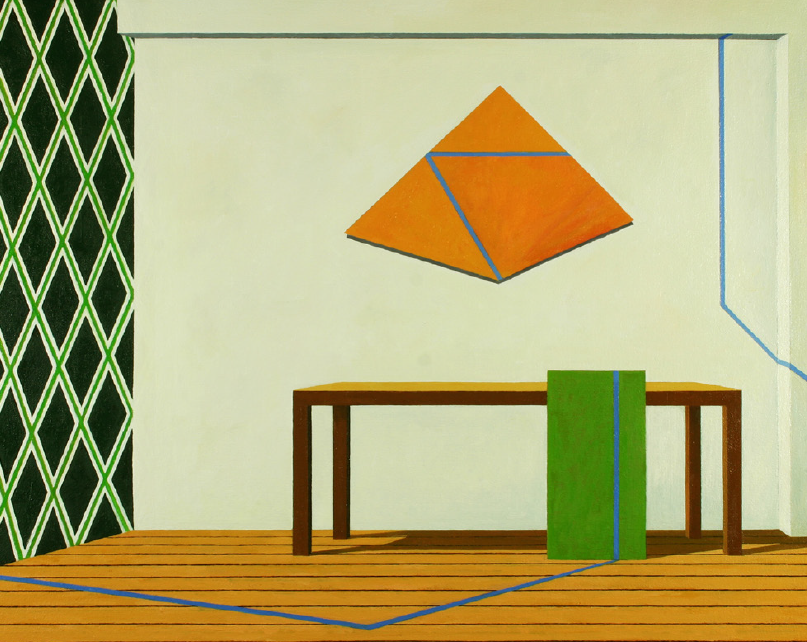
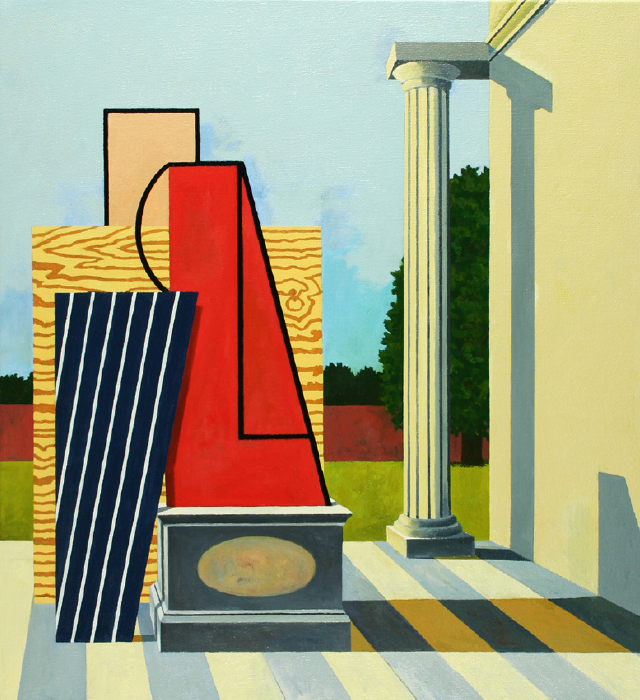
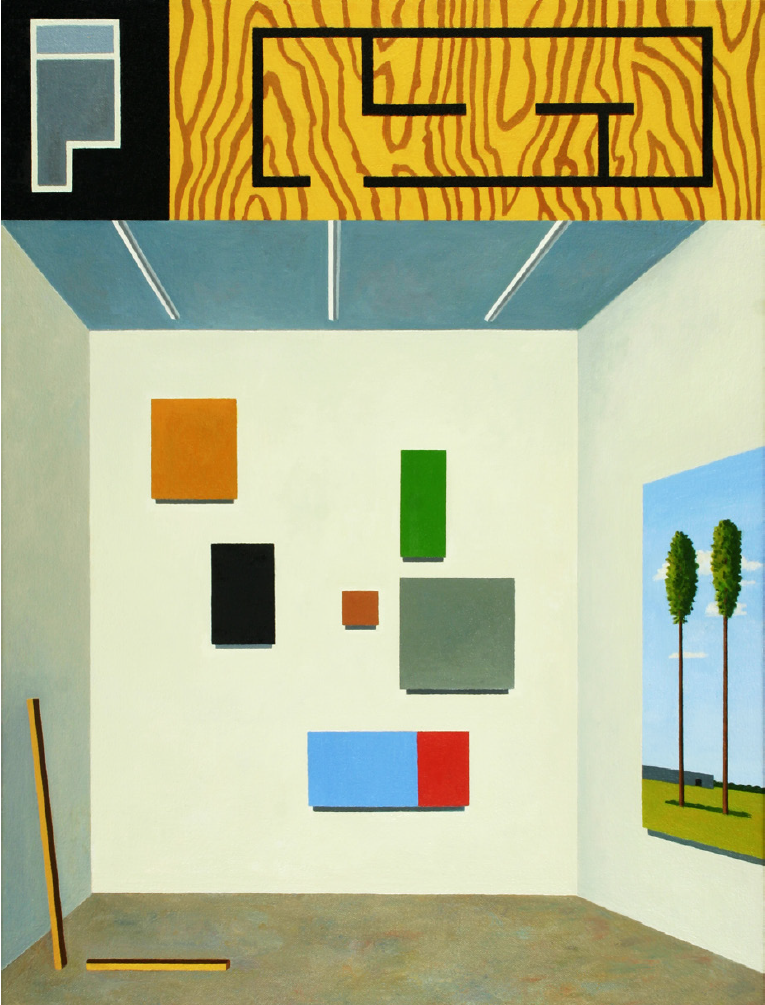
Much of Mühsam’s earlier work had attended to the landscape as an unwitting blank slate for human intervention. In some cases, the results are beautiful, with Mühsam’s architectural imagination running free over an otherwise bucolic mise-en-scène. In other cases, the results are predictably late-capitalist: outsized storage units impose boring, boxy volumes on a world with no means of resistance to the grids we’ve given it. Some of Mühsam’s most poignant works of the last few years are those that involve shipping containers, the silent, ubiquitous, and decidedly train-sized cages for commercial products that circumnavigate the globe. One is reminded of freeport art-storage hubs described by Hito Steyerl in Duty Free Art and the degree to which the containment, transportation, and storage of art has surpassed the presentation of it: “For all we know, the crates could even be empty. It is a museum of the internet era, but a museum of the dark net, where movement is obscured and data-space is clouded.”³ Like Miller Gross, Mühsam is attentive to how technologies of the built environment alter the natural world, and, perhaps more acutely, he invites the question of how human forms coexist within it, from the tables and columns that crop up in works like Strategic Intuitions and Dialectic Classicism to the diagrammatic room designs in Formalist Generalizations that stand in for the networked grids that logic our everyday lives.
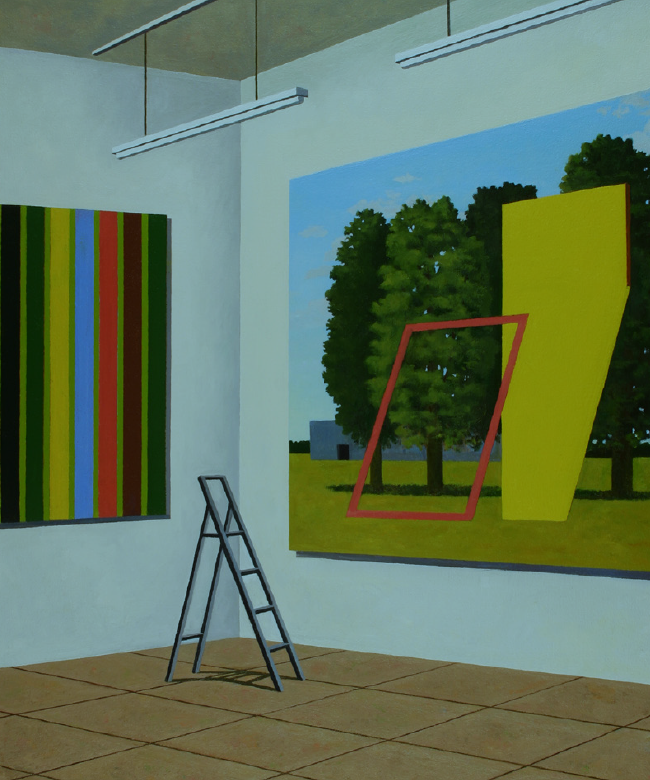
Mühsam’s newer paintings in SiteParallels offer a world of forms that enclose without displacing, that demarcate self-contained territories while at the same time indulging the flatness afforded by the painting plane. His uncanny interiors and exteriors reference a world that exists in an alternate history of art history. This is a world in which one recognizes, or at least imagines, certain touchstones, but only through a kind of déjà vu, that hazy, imprecise feeling that you’ve seen this before, but it’s not this. The Salvaging of an Idea depicts the corner of a studio space in which a painting of vertical stripes is hung across from a work depicting a landscape scene with a canary-yellow polygon, akin, perhaps, to one of Ellsworth Kelly’s totems, albeit styled here with far less reserve. The shape is paired on the plane with a pink outline of a parallelogram to its left, delimiting and circumscribing space. As much as the painting, within a painting, seems to depict two works of sculpture, however, their formal presence is that of shapes, not of figures. The trees cast shadows, but the shapes do not. They aren’t there, therefore, but they also clearly aren’t not. A gray rectangular form in the distance lingers conspicuously beyond the trees. The shape scans as one of the countless, nondescript warehouses or inventory centers that pixelate the American suburban landscape to feed the supply chain of global capitalism.
Georges Didi-Huberman has written that “in each historical object, all times encounter one another, collide, or base themselves plastically on one another, bifurcate, or even become entangled with one another.”⁴ Time is like the intersecting fibers of Miller Gross’s felt, compressed and overlapping at random, reliant on the artist to impose stability. Time is like the shapes and lines that comprise the impossible objects on Mühsam’s canvases, entangled order, depth without weight. Perhaps the most profound parallel shared by Miller Gross and Mühsam is not a parallel at all, disconnected by definition, but rather that they create work at which intersections convene, becoming even more.
Chicago, IL
September 2018
Image captions:
Armin Mühsam
Strategic Intuitions, 2018
oil on canvas
24 x 30”
Dialectic Classicism, 2018
oil on canvas
24 x 22”
The Salvaging of an Idea, 2018
oil on canvas
26 x 22”
³ Hito Steyerl, Duty Free Art: Art in the Age of Planetary Civil War
London and New York: Verso, 2017, 83.
⁴ Georges Didi-Huberman, “Has the Epistemological Transformation Taken Place?” trans. Vivian Rehberg, in The Art Historian: National Traditions and Institutional Practices, ed. Michael Zimmerman Williamstown, MA: Clark Art Institute, 2003, 131.
Image caption:
Armin Mühsam
Formalist Generalizations, 2018
oil on canvas
24 x 18”
Credits
Photography by E.G. Schempf
Layout + Design by Kelly Chesley
Kansas City, MO
hawcontemporary.com