Review: Wooly Mammoth: Re-Purposed
By: Mary Ann Strandell
August 2008
Review Magazine
Marcie Miller Gross: a part
Review Studios Exhibition Space
Kansas City, Missouri
May 9 - June 20, 2008
Walking softly, you might hear a pin drop or tethers of wool shift as you pass by. There is a low murmur, a resonance among the dense, draping, placed wool forms that compose Marcie Miller Gross’ latest installation, a part. The elegant coiffed structures of cut wool come to fruition in the spacious industrial setting of the Review Studios gallery. The exhibition takes on new territory for Gross, echoing the voice of her folded and stacked sculptures for which she is known. She reaffirms this previous work while enlarging the terrain of a multi-layered language.
This exhibition is comprised of four works that vary in scale and form. Each carries its own voice and encompasses different sensibilities. All are made from used, felted-wool sweater parts.
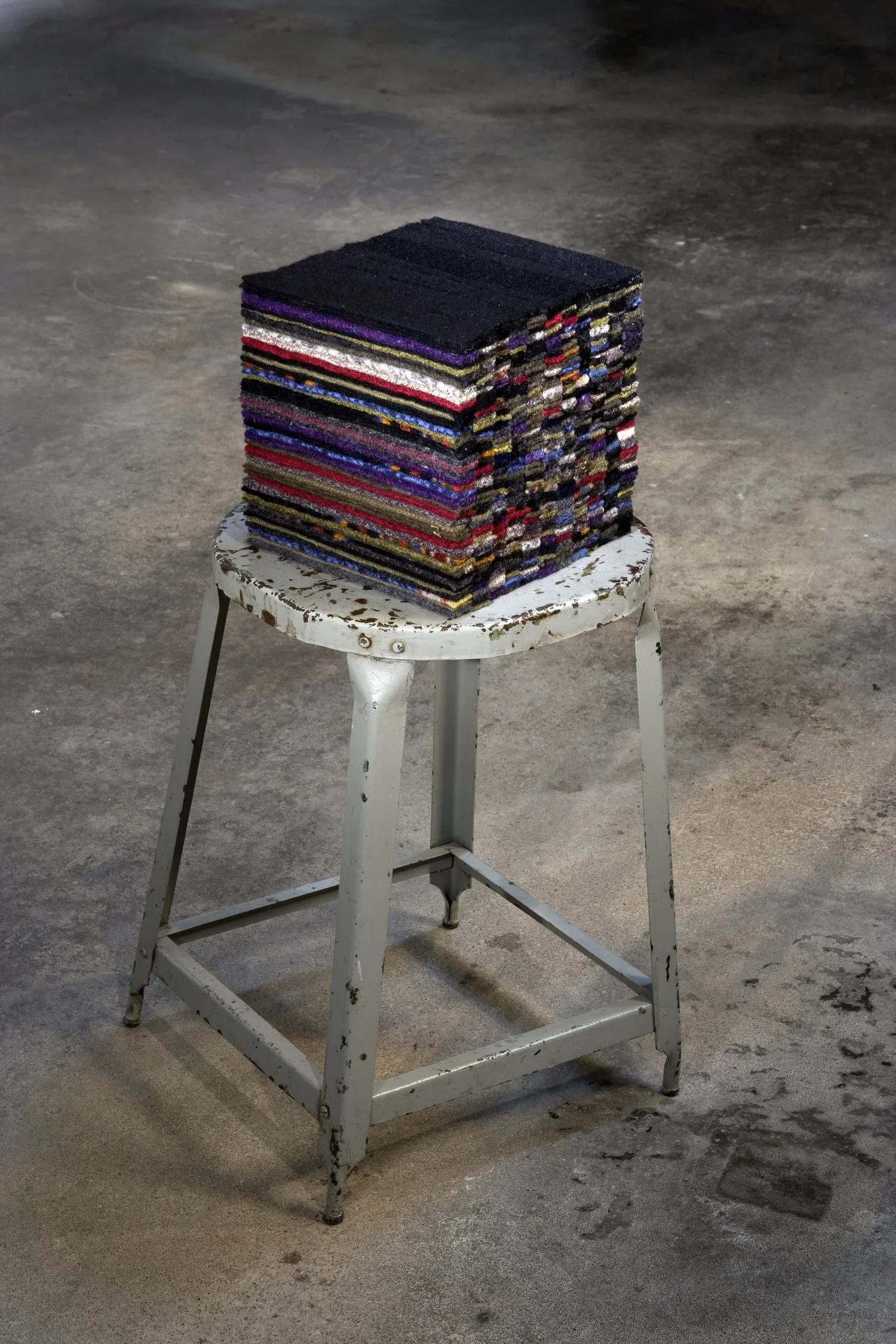
The most intimate piece, Flex (cube), is a small piece of stacked cut wool that forms a block on top of a small metal stool. It is the only piece in the exhibition that references prior work, namely Gross’ 2005 foldover exhibition at the Kemper Museum of Contemporary Art. There, cut felt was stacked from floor to ceiling, with other cut sheets free standing. In a 2007 group exhibition at the Byron Cohen Gallery, Gross used stacked surgical towels as her primary media, and in her works from 2001 and 2003, she predominately used terrycloth bath towels and shelving. Like the previous works, Flex (cube) is a freestanding vertical monument that still uses the vernacular of household life, the stool. This work marks the change from the past into the newer work and into the rest of the exhibition. It is the exhibition’s starting point.
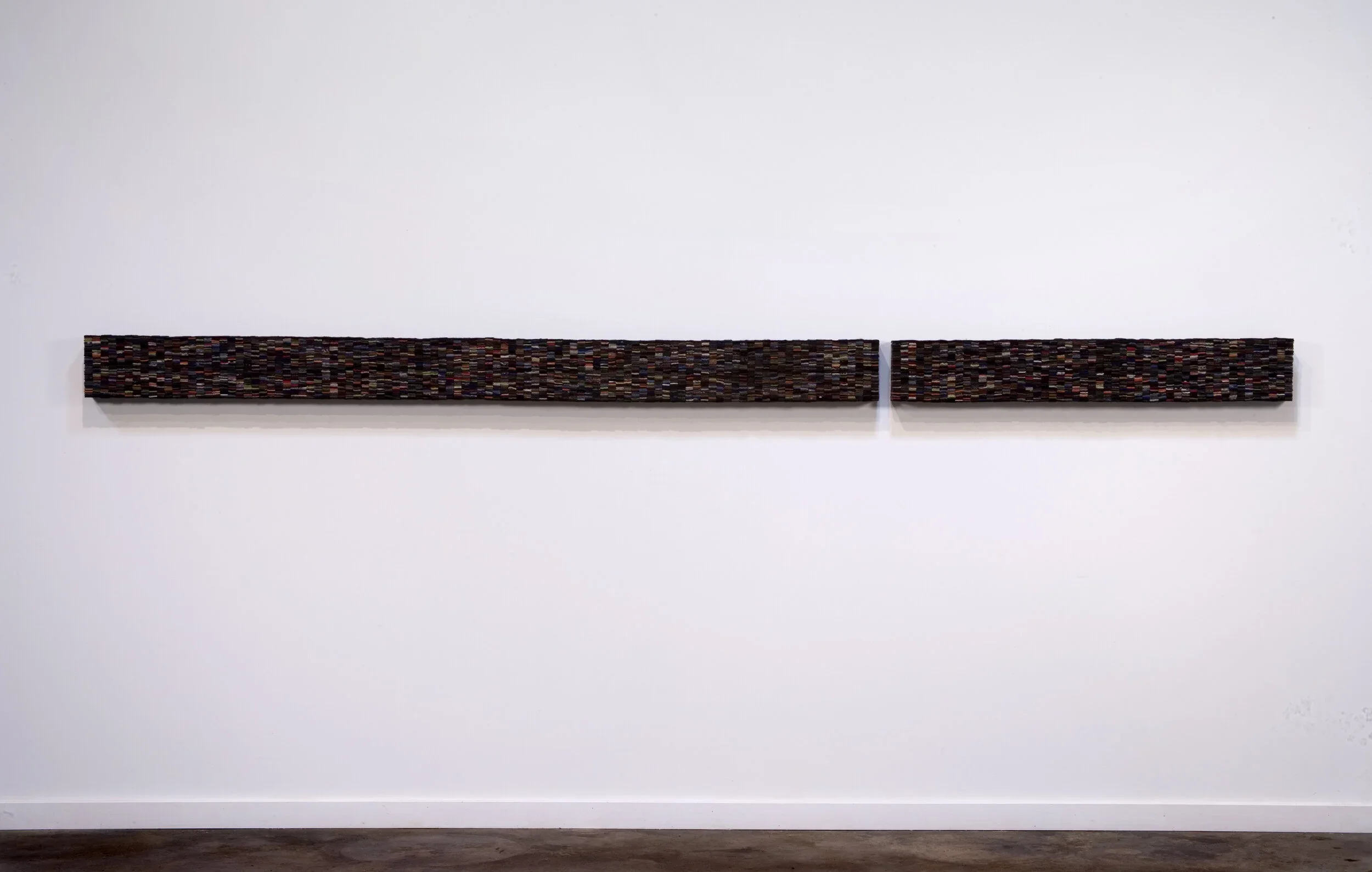
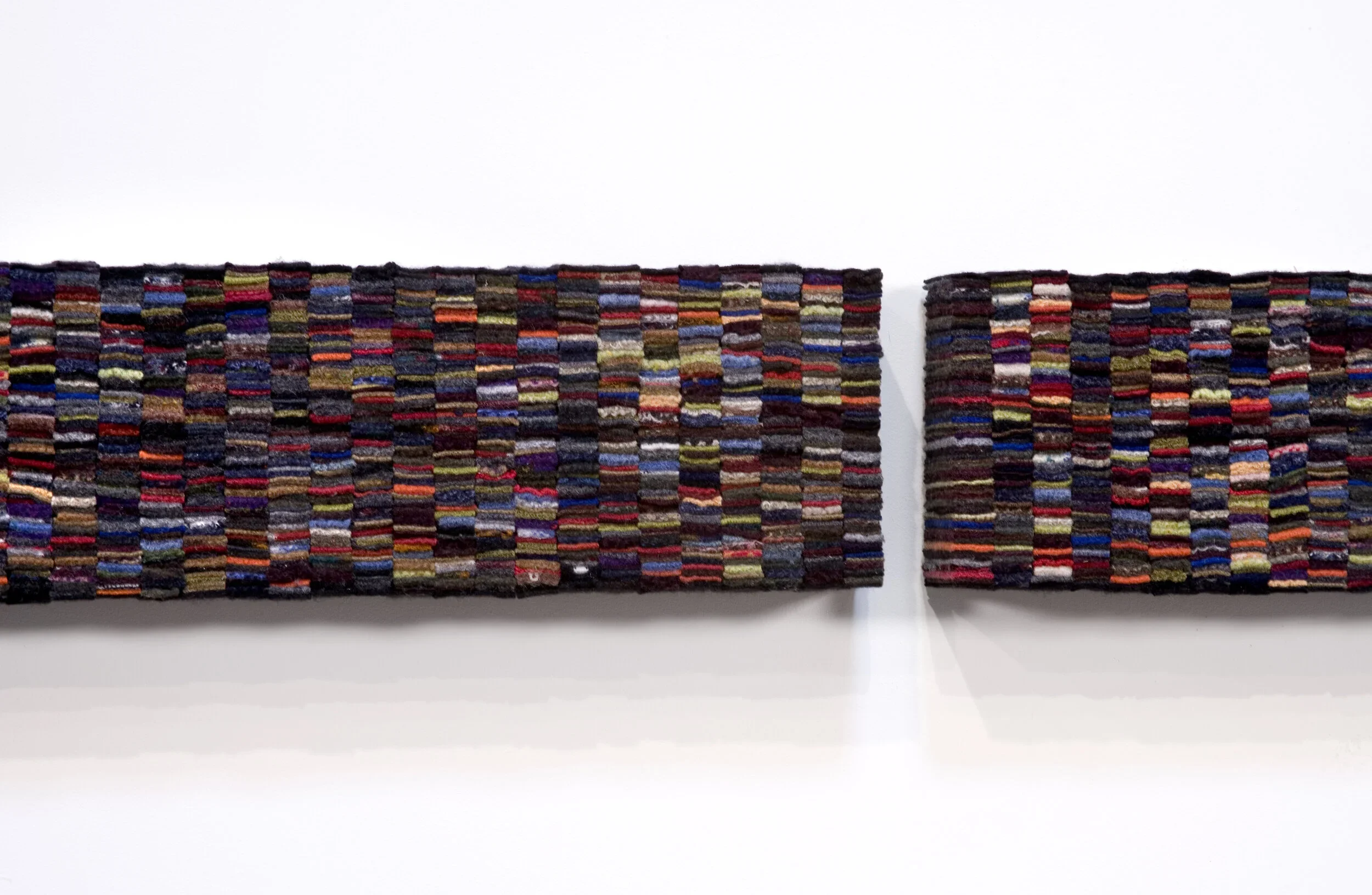
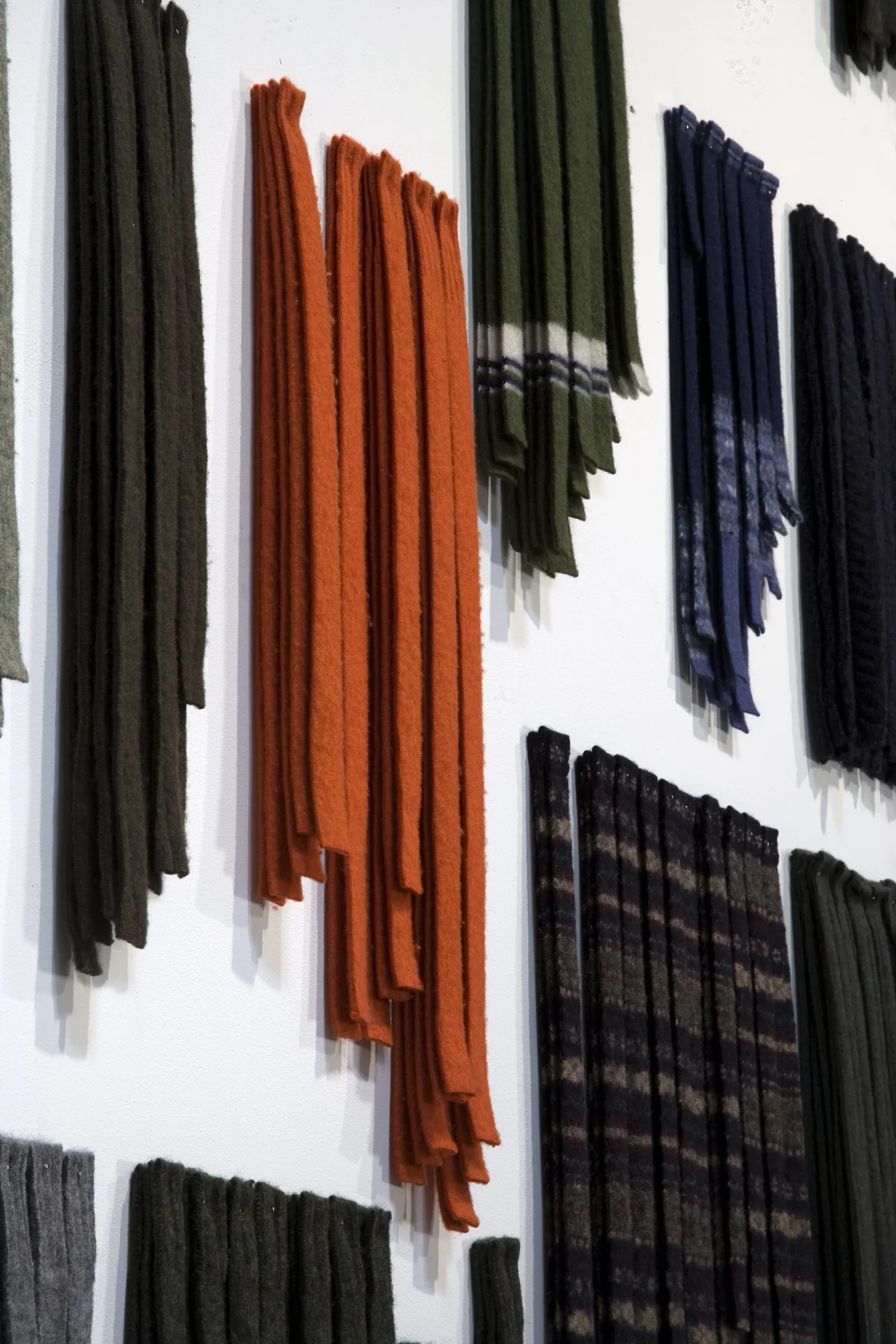
On the far north wall of the gallery is a wall piece hung at eye level titled Flex (line). Helping to anchor the room of smaller repetitious forms, it is a long rectangular shape, divided into two unequal sections, with the immediate presence of the familiar. Its linear nature cuts the wall into two planes; comprised mostly of earth tones, with various layers of red, green, and blue dispersed across its frontal plane, the form has inherent dichotomies. At a distance, its presence speaks of mass. It feels strangely like a solid building material, such as steel or a wood plank. Yet up close to the piece, one experiences the textured fiber patterned into one-inch-wide color patches that create an erratic grid.
With an architectural pattern akin to stacked compartments or apartments in miniature, Flex (line) recalls Donald Judd’s Minimalist works, specifically the elongated linear anodized aluminum works such as Untitled (1970, part of the Solomon R. Guggenheim Museum’s Panza Collection). In this piece, Judd emphasized the “thing as a whole” rather than a composition. Everything is subsumed to the larger experience.
Although Gross converses with minimal and post-minimal strategies, Flex (line) loses the coolness celebrated by Judd’s machined aluminum and harder metals. She breaks up the mass with pattern and with the dense sound-absorbing material. The deep silence that is elicited in these pieces is a contrast to Judd’s metallic constructions. These are condensed, put, and pushed into place, instead of built, banged, welded, and riveted. Repurposed sweaters once destined for retail shelves are her media, and the rich dense material tells its own tale of its animal roots and of utility as a product of commerce or fashion. It also recalls a relation to the human body, the once-worn sweaters and those histories. These layered references and materiality within the context of a part suggest a “social site,” the material’s history prior to its location within the gallery.
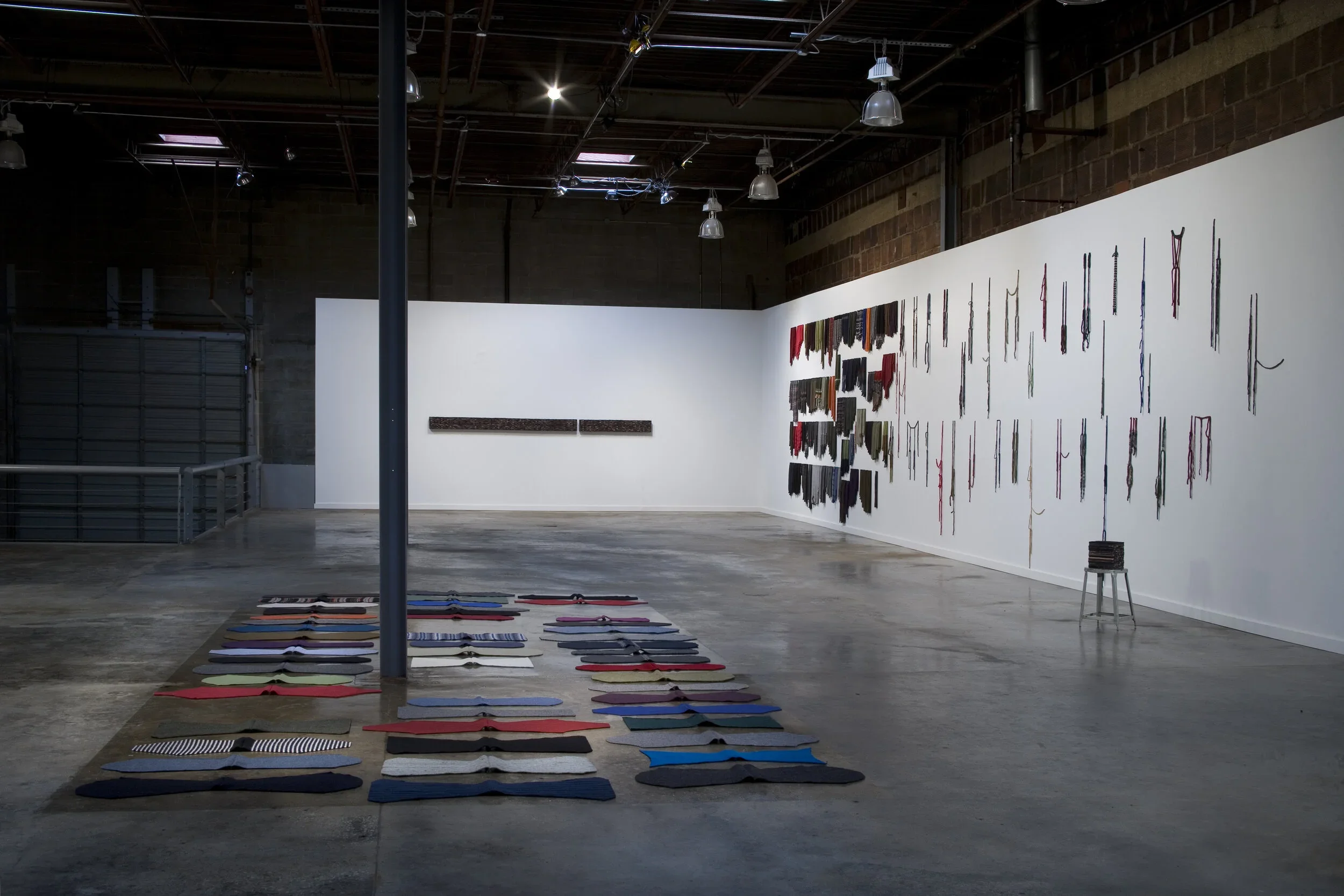
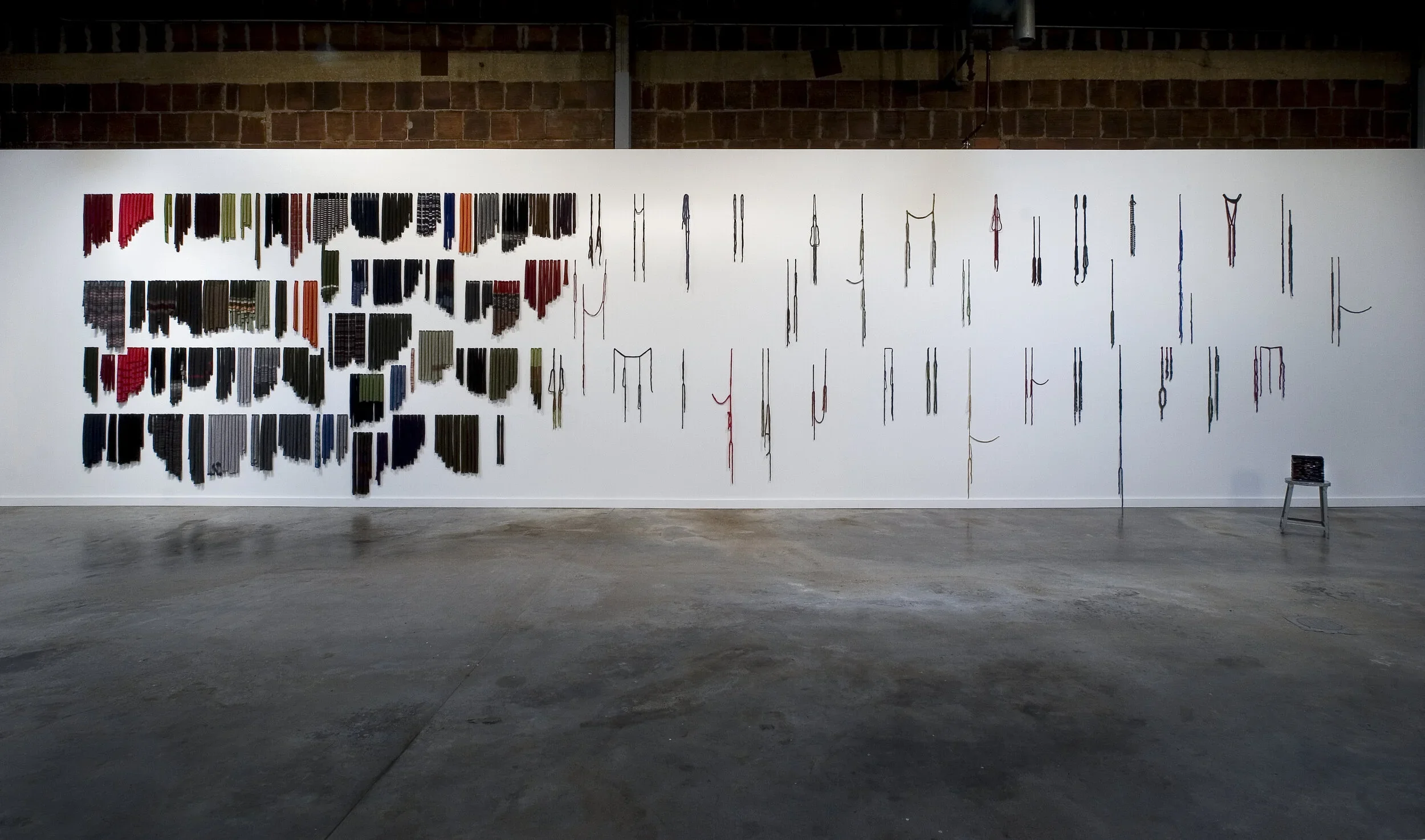
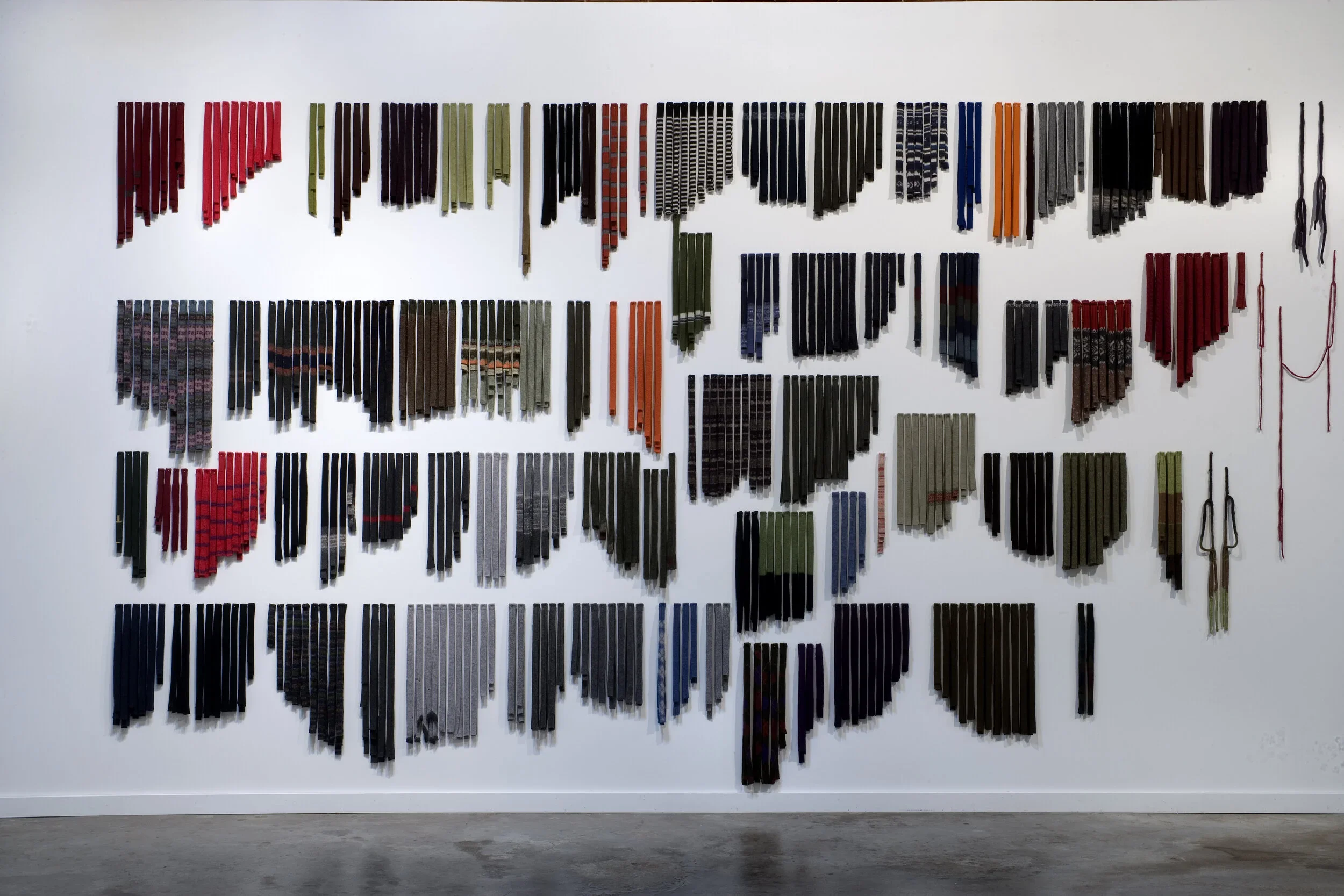
Inventory is an expansive piece that uses sweater parts and seams pinned directly to the wall. The left half of the wall is made up of densely placed flat wool strips, and the right half is thin, scantly placed elongated fibers of bound and rounded wool. The small groupings of thinly cut wool strips are attached to the wall on a very even linear visual edge. The strips hang in different lengths, leaving a variegated bottom edge. These parts and groups hang in clusters of color, and additional pattern is created by the negative space around each piece. They form handsomely placed rows that read like a book, a science graph, or a new line of garments in a Prada store’s streamline display.
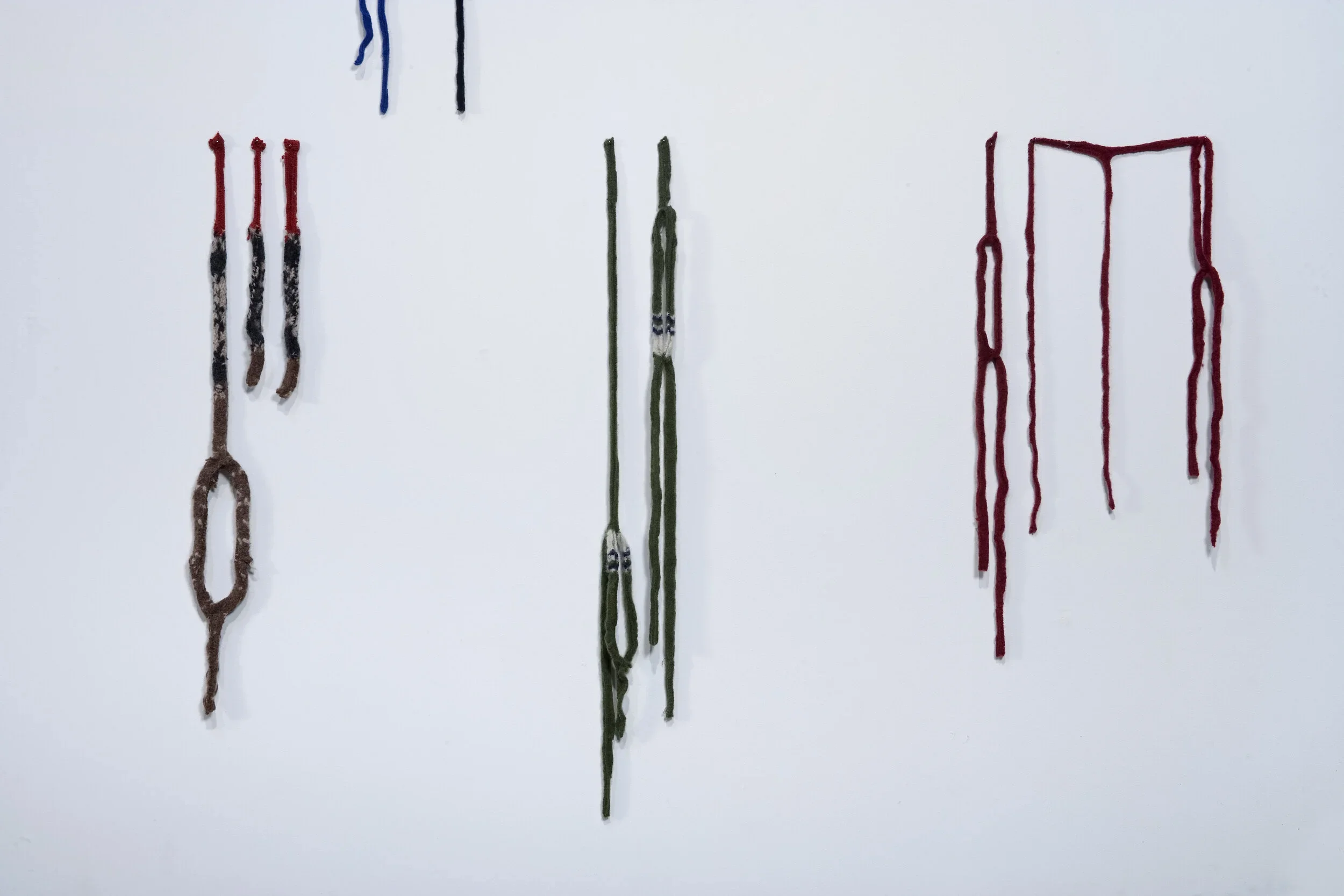
The other half has a freer form to its placed bound strands; a couple of them nearly touch the ground. Hung along their own even horizontal lines, they look like jewelry from a distance; close up they resemble roots or even human dreadlocks. The ensemble of sweater seams has a tenor to science, commerce, and to the silk dye rooms of South East Asian textile co-ops that I visited in the late 1990s.
In Re-pair, Gross hits her stride. Fifty-two ready-made wool sweater sleeves joined at their cuffs are carefully laid on the floor of the gallery in three rows. Each shape is similar, much like an hourglass form. I immediately thought of them as shields or bodices, not as sleeves. Few are multi-colored. Most are a solid color, a shade of pale lavender or a mix of light brown fibers, a celadon green, an occasional brilliant red. The group is somewhat of a grid, but leaves several gaps between the forms to invite you to walk through or onto a side row. The conversation of floor real estate as a composition is in keeping with Polly Apfelbaums’ painted synthetic velvet bursts of color. Gross’ piece is more like Chinese painting in its desire to embrace infinity, where all four sides are free to expand without a horizon line. The floor panels are like rugs of ornament, ground cover. The pattern and placement denote a reverie of hearth and garden patches.
The two large wall pieces, Flex (line) and the more expansive Inventory, both record a form of artistic practice of repetitive labor, of the cutting, stitching, and handling of fiber. Gross has a profound relationship to this handiwork, with techniques and sources transformed from a lineage of feminist artists who consider these materials and practices once labeled “women’s work.” Gross embraces these early actions as labor and art to change the viewing process to reconsider space and form and its origin(s).
Gross has created a potent use of language that espouses meaning through cultural, social, and historical situations. The social site of these soft structural forms, in part, opens our senses and renews our perception.
Marcie Miller Gross is a Review Studios Artist.
Image captions:
Left: Flex (cube), side view, 2006, felted wool sweater parts, found stool, 12” x 12” x 26”.
Right: Installation view of Re-pair foreground, Flex (line) back wall, Inventory right wall, Flex (cube) stool at right, 2008, used felted wool sweater parts and seams, pins, found stool.
Facing page: Flex (line) detail, 2008, used felted wool sweater parts, 156” x 3” x 8”.
All photos: E.G. Schempf.
Author bio:
Mary Ann Strandell is a painter living in the New York City area. A former professor at the Kansas City Art Institute in Kansas City, Missouri, and at Washington University in St. Louis, Missouri, she has upcoming solo exhibitions at Wells College, Aurora, New York; at the Real Form Project Space, Brooklyn, New York; and at the Deborah Colton Gallery, Houston, Texas. Her work appears next month as part of the group exhibit-in-print, Natural History on the Head, at The Kansas City Museum.